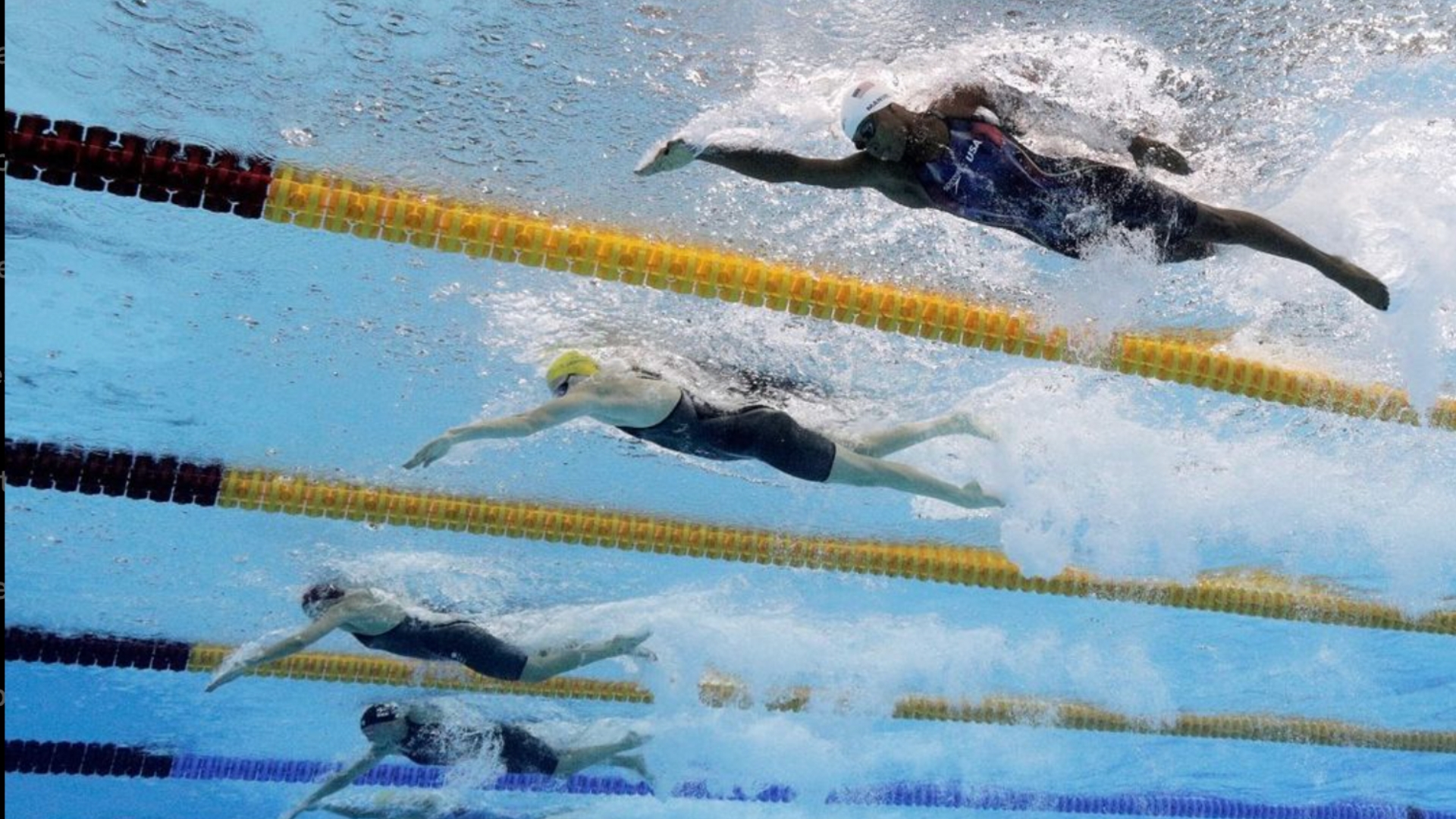
Australian Olympian and current swimming coach Brett Hawke questioned the incredible world record set by Pan Zhanle in the 100 metres freestyle at the Paris Olympics following doping allegations against Chinese swimmers. But Australian Kyle Chalmers, who won silver in the event, felt the Chinese star was deserving of the victory.
Pan, a teenager, won the gold medal at the Olympics with a time of 46.40 seconds, smashing his previous best time of 46.80 seconds achieved in February. However, Pan had barely made it to the semi-finals with a time of 48.40, two seconds slower than his best.
Hawke, who coached Cesar Cielo of Brazil, the first person to break the 47-second mark, asserted that the world record time was possible. He admitted: “Listen, I’m just going to be honest. I am angry at that swim, I’m angry for a number of reasons… My friends are the fastest swimmers in history — from Rowdy Gaines to Alex Popov to Gary Hall Jr, Anthony Irvin, all the way up to King Kyle Chalmers…I know these people intimately, I’ve studied them for 30 years. I’ve studied this sport. I’ve studied speed. I understand it. I’m an expert in it, that’s what I do, okay.”
“That’s not real, you don’t beat that field — Kyle Chalmers, David Popovici, Jack Alexy — you don’t beat those guys by one full body length in 100 freestyle. That’s not humanly possible, okay,” he added.
In relation to doping allegations
The victory occurred in the midst of a drug scandal that shattered the Chinese swim team just before the Paris Olympics and prompted US officials to charge WADA, the anti-doping organization, with staging a cover-up.
Twenty-three Chinese swimmers tested positive for the drug trimetazidine (TMZ) at a local competition in late 2020 and early 2021, just before the Tokyo Olympics, according to a story published in the New York Times in April. WADA accepted the explanation provided by Chinese officials, stating that food contamination was the cause of the positive tests.
However, Pan was not among the 23 swimmers in the report.
Pan declared: “Last year I received 29 tests, and it has never been positive… I was tested after the race and we will see the result.”
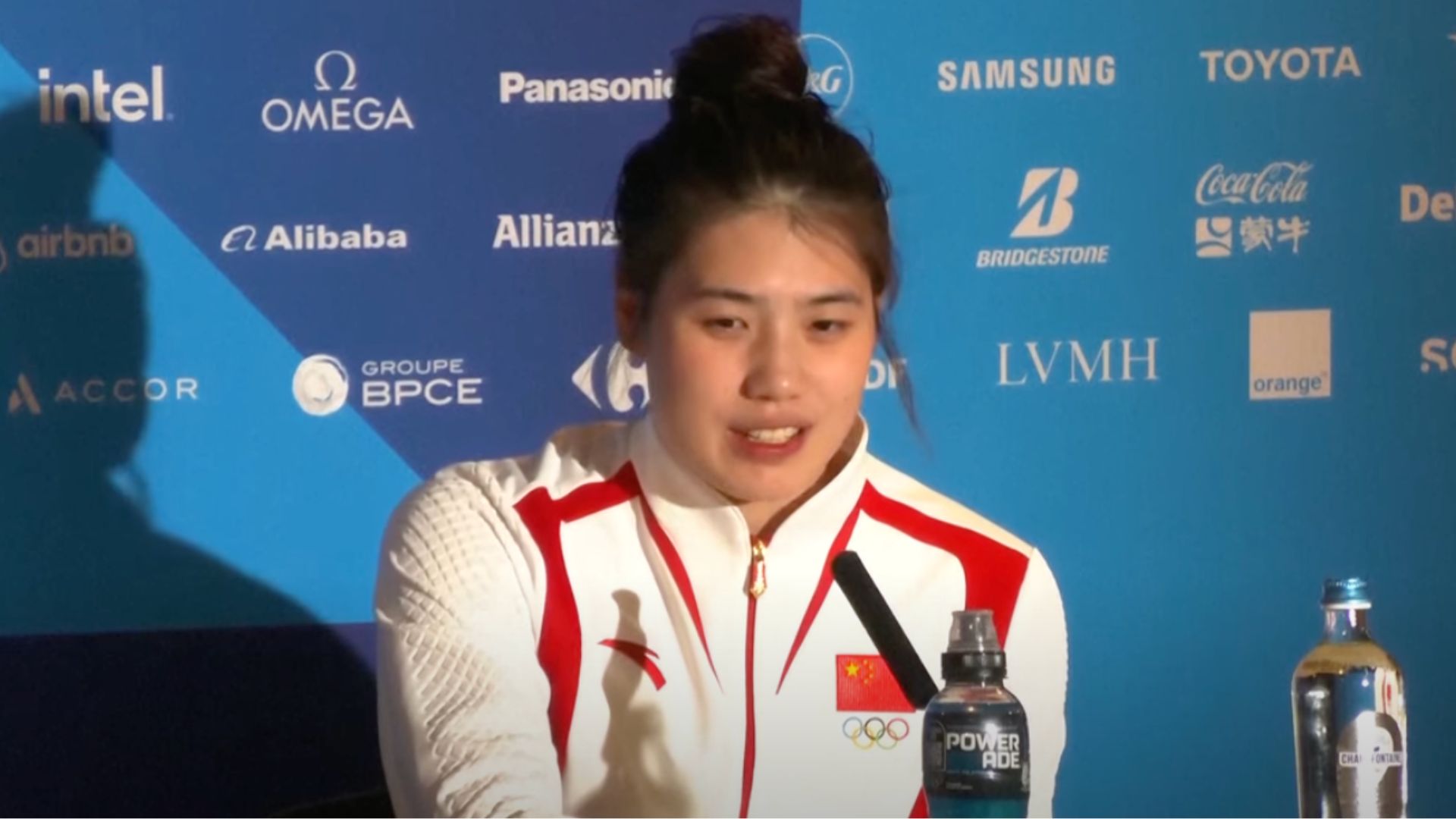
China’s most decorated Olympic swimmer Zhang Yufei with three Paris Olympics medals already in her bag didn’t mince words when an Australian reporter questioned the legitimacy of her male compatriot Pan Zhanle’s new world record. Pan’s success was the result of the hard work, she said. Why are questions raised about the Chinese and not those from Western countries, she asked.
Zhang was among the 23 Chinese swimmers allowed to compete in the Tokyo Games three years ago despite testing positive for a banned substance, the New York Times and German broadcaster ARD reported in April. The Chinese said they tested positive because they inadvertently ate contaminated hotel food. Since then they have undergone intensive drug tests to be eligible for the Games.
Medals for Zhang Yufei
Zhang, called the “butterfly queen’ in China, won bronze in the 200-metre butterfly in Paris on Thursday (August 1) despite suffering from fever and dysmenorrhea (painful periods or menstrual cramps), reported China’s Global Times. She had also won bronze in the 100-metre butterfly and the 4×100m-metre women’s freestyle relay, where China finished third behind Australia and the United States.
The 26-year-old said she was impressed with herself for being able to take part in the 200-metre butterfly despite her physical condition.
“I think this is probably one of the most difficult races I’ve had at these Olympics. I’m much better now, but when I was swimming my hands were a little bit numb because right now I am on my period and I was also in pain during the race,” she told the Xinhua News Agency.
Zhang is now the most decorated Olympic swimmer from China with seven medals from Tokyo and Paris. “I hope to use my performance to gain recognition for Chinese athletes, showing that we are not just a flash in the pan but can be as enduring as foreign athletes,” she said.
The Chinese swimming team has won one gold, two silvers and four bronzes in Paris – the gold won by Pan Zhanle, who broke the men’s 100-metre freestyle world record, on Wednesday (July 31).
Pan, 19, won the 100-metre men’s freestyle in 46.60 seconds, shaving 0.40 seconds off the mark he set at the world championships in Doha, Qatar, in February.
Some found Pan’s achievements “unbelievable”, said an Australian reporter at a press conference.
Zhang on Pan
Zhang replied that Pan’s success was the result of hard work and should not be viewed with scepticism.
“Pan had consistently swum under 47 seconds prior to achieving his new world record, indicating a stable and continuous improvement rather than a sudden leap in performance. Pan’s achievements were legitimate and attained under stringent anti-doping protocols,” said Zhang.
“Why are Chinese athletes questioned when they achieve fast times, yet no one doubted Michael Phelps when he won seven or eight gold medals? Similarly, Katie Ledecky has dominated long-distance swimming from 2012 to 2024, winning gold in every event, yet no one questioned her performances?” she added.
Chinese swimmers have undergone frequent doping tests, especially during the week leading up to the Paris Olympics, the Global Times reported.
Zhang told the Xinhua News Agency earlier that in the two months leading up to the Paris Olympics, every Chinese swimmer was tested 20 to 30 times, averaging three to four tests per person per week.
After winning the 100-metre freestyle on Wednesday, Pan said:”Last year, I underwent 29 tests, and not once did I test positive. This year, from May to July, I had 21 tests, and again, not a single positive result.”
Pan was not one of the swimmers named in the New York Times investigation.
Chinese Olympic champion Zhang Yufei has appealed to people to “look at the Chinese swimming team through an unbiased lens in response to the unfair treatment and criticism that Chinese swimmers are facing”, reports China’s Global Times.
Zhang, who was one of 23 Chinese athletes who tested positive for a banned substance before the Tokyo Olympics, said on Saturday (July 27) that she and her teammates had been wrongly accused of doping and insisted that China would never allow any athlete to use performance-enhancing drugs, reports the New York Times.
China claims the athletes inadvertently ate contaminated hotel food, a claim reiterated by Zhang.
“I don’t think any athlete, Chinese or non-Chinese, would want to destroy the work they built up every day over the years on doping,” Zhang said in Paris on Saturday (July 27) in the first public comments by a member of the Chinese swimming team at the centre of the doping scandal, reported the Times.
Zhang wins two medals
Zhang, who won gold in the 200-metre butterfly at the 2020 Tokyo Olympics, claimed two medals in Paris on Saturday. She picked up bronze in the 100-metre butterfly—an event in which she won silver in Tokyo—and helped China finish third in the 4×100-metre women’s freestyle relay.
Zhang, Yang Junxuan, Cheng Yujie and Wu Qingfeng clocked a time of 3 minutes 30.30 seconds in the 4×100-metre, setting a new Asian record.
Australia, nevertheless, won the women’s relay, keeping the crown they won in Tokyo, the team made up of Emma McKeon, Mollie O’Callaghan, Meg Harris and Shayna Jack.
The United States came second, with Simone Manuel, Gretchen Walsh, Torri Huske and Kate Douglass making up the team.
Chinese men finish fourth
The Chinese women fared better than the men who, after a strong start, finished fourth in the 4×100-metre freestyle relay. The United States won gold, with Jack Alexy, Chris Guiliano, Hunter Armstrong and Caeleb Dressel on the team. Australia took silver and Italy bronze.
Pan Zhanle gave China a head start, chalking up 46.92 seconds in his leadoff split in the men’s relay, breaking the Olympic record for the men’s 100-metre freestyle. But the United States rallied and won the race in 3:09.28, retaining the crown they had won in the 2016 Rio de Janeiro Games and defended in Tokyo.
“My performance was not good enough. If I had created a greater advantage, we could have reached the podium,” said Pan, the world record holder in the 100-metre freestyle.
China’s Zhang Yufei said on Sunday that she was satisfied with her bronze medal in the women’s 100m butterfly at the Paris Olympics, her second podium finish in the event. #Paris2024pic.twitter.com/IDZAFQ2UYM
Zhang, meanwhile, faced the Americans Torri Husk and Grethen Walsh also in the 200-metre butterfly. Huske won the race, and Walsh finished second, pushing Zhang to third place.
Seen weeping after the award ceremony, Zhang said, “Perhaps I’ve pushed myself too hard.” She added, “I did feel a lot of pressure, but I also believe in my own abilities and look forward to competing against strong opponents next time.”
Her hometown fans consoled her. The hashtag “#YufeiDon’tCry” surged to the top of Weibo’s trending list. “Don’t cry, Yufei! We’re so proud of you. You’re really, really good,” one Weibo user commented.
China concern over large number of drug tests
China is worked up over the intensive drug testing of Chinese athletes following doping allegations.
Zhang told the Xinhua News Agency that in the two months before the Paris Olympics, every athlete on the Chinese swimming team was tested 20 to 30 times, averaging three to four tests per person per week.
Some suspect the tests are affecting the athletes.
“Something must have gone awry with the athletes’ pre-competition training. Personally, I believe that seven doping tests in one day might have disrupted our Chinese swimming team,” highly decorated Olympic diver Gao Min wrote on Weibo.
Zhang appeals for understanding
Zhang appealed for understanding in an Olympic poolside interview after advancing to the semi-finals of the 100-metre butterfly.
“Before last year, and before the scandal broke out, I got along really well with competitors from other countries. Now at this Olympics, I’m really worried that my good friends will look at me differently, that they would be unwilling to compete with me or watch me compete,” she said.
“I’m even more worried that the French public would think that Chinese athletes do not deserve to compete at this stage, so I feel very misunderstood.”
Qin Haiyang of China: The first Asian to be named Male Swimmer of the Year
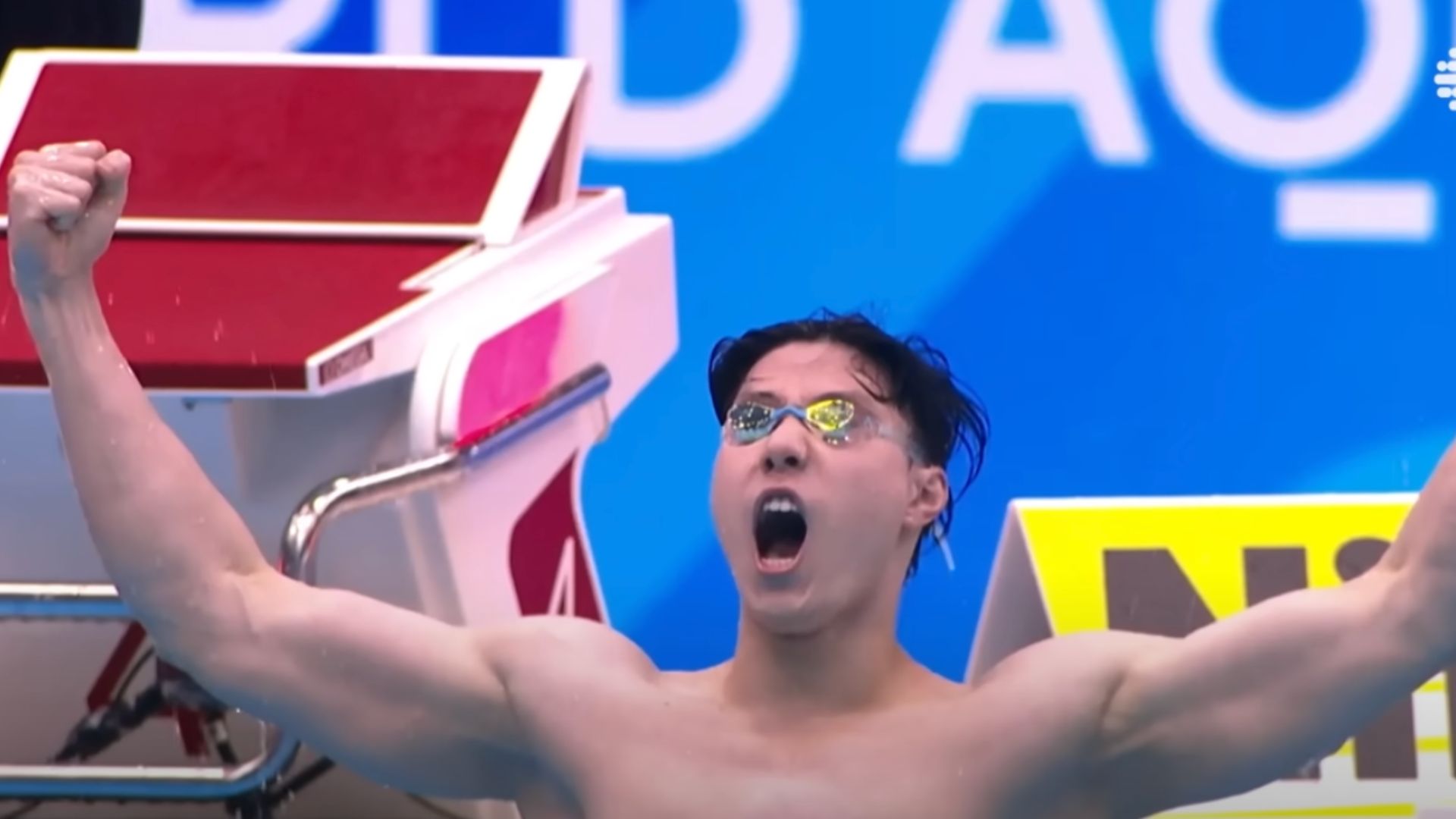
China’s Qin Haiyang holds the world record in the 200 metres breaststroke, which he set at the 2023 World Aquatics Championships in Fukuoka, Japan. He swept to a 50, 100 and 200 metres treble in Fukuoka, becoming the first swimmer in history to win all three breaststroke events at a single edition of the championships.
Subsequently, at the 2023 Swimming World Cup, Qin won gold in all three breaststroke events (50m, 100m, and 200m) at all three World Cup legs, held in Berlin, Athens and Budapest.
Thanks to his scintillating performance, in 2023, Qin became the first Asian to be named the Male Swimmer of the Year by World Aquatics.
— Chris Labrusca (not an alt) (@christherebooot) July 27, 2024
Doping controversies
However, the 25-year-old swimming sensation will be among the Chinese swimmers swimming under a cloud in the Paris Olympics because of doping controversies,
He was allegedly among the 23 Chinese athletes allowed to compete in the Tokyo Games despite testing positive for a banned drug.
This was revealed in April 2024 following a joint investigation by the New York Times and the German television channel ARD.
The World Anti-Doping Agency (Wada) accepted China’s explanation that the kitchen at their hotel had been contaminated but promised to increase the level of testing of Chinese athletes competing in Paris.
Meanwhile, in June 2024, the New York Times further alleged that Qin, along with swimmers Wang Shun and Yang Junxuan, had also tested positive several years earlier for a different performance-enhancing drug but had escaped being publicly identified and suspended.
Unhappy competitors
The controversy has left several Olympic competitors in Paris unhappy with Wada’s handling of the affair.
Australian swimmer Zac Stubblety-Cook, the former 200-metre world breaststroke record holder, said he was considering a poolside protest against the Chinese competitors in Paris.
Qin has accused American and European athletes of conspiring to distract Chinese athletes from their Olympic preparations.
“Some tricks aim to disrupt our preparation rhythm and destroy our psychological defence! But we are not afraid. When you have a clear conscience, you do not fear slander. The team is currently preparing at the established pace. My teammates and I will resist the pressure and win more medals to silence the sceptics!” he said.
Adam Peaty, a three-time Olympic gold medallist from Great Britain, called on the World Anti-Doping Agency (Wada) to do their jobs right and stated that Chinese athletes who are deemed to be cheating should be removed from the sport.
In the men’s 4×100-metre medley relay, China won gold in 3 minutes, 24 seconds, surpassing the US by 0.55 seconds and the bronze-winning French team by 0.92 seconds. Peaty, whose British team placed fourth overall with a performance record of 3:29, hinted that there might have been more going on in the race.
The athlete said: “In sport, one of my favourite quotes I’ve seen lately is ‘There’s no point in winning if you don’t win it fair’… I think you know that truth in your heart… Even if you touch and you know you’re cheating, you’re not winning, right?”
“So, for me, if you’ve been on that and you have been contaminated twice, I think as an honourable person, it means you should be out of the sport. We know sport is not that simple,” Peaty added.
Discontent with the system
Peaty claimed he kept quiet about the issue during the Games in order to maintain his composure, but that he finally felt it was appropriate to voice his displeasure with the system.
He declared: “We’ll see how they do in four years’ time, but I think the people that need to do the job will wake up and do the job… We’ve got to have faith in the system, but we don’t… It’s just got to be stricter. What I’ve said from the start is that it is a fraud. If you’re cheating, it is fraud.”
Qin Haiyang and Sun Jiajun, two of the four swimmers from China’s relay team, were among the 23 swimmers who tested positive for a prohibited heart medicine prior to the 2020 Tokyo Games, but Wada let them compete in Paris. Wada supported its ruling, but subsequently, two swimmers who tested positive for a prohibited steroid in 2022 have been accused of doping again, as reported by The New York Times.
While he believes the two situations are unjust, Peaty clarified that he does not mean to generalize about all Chinese athletes. He said: “I don’t want to paint a whole nation or a whole group with one brush, I think it’s very unfair… But there have been two cases of it and I think it’s very disappointing, and I’ve tried to keep out of the conversation until now for the betterment of the team… I think we’re going to use that to our advantage the next four years, whether I’m there or not.”
A number of Chinese swimmers, like Qin and 10-time Olympic medallist Zhang Yufei, have defended themselves, saying that their opponents are threatened and that they are innocent of any doping charges. Athlete Qin remarked: “Some tricks aim to disrupt our preparation rhythm and destroy our psychological defense… But we are not afraid.”
Michael Phelps, a famous Olympian swimmer, testified before Congress that years of doping accusations affected his mental health. He now feels that Chinese sportsmen are abusing an unjust system by engaging in these unlawful acts.
The athlete admitted: “The constant suspicion of doping deeply eroded the mental state it took a lifetime to build while competing at the highest levels.”
Prior to the August Olympics in Paris, Phelps and swimmer Allison Schmidt testified before a House subcommittee investigating a doping case involving Chinese athletes. He further declared: “As athletes, our faith can no longer be blindly placed in the world of the anti-doping agency, an organization that continues to prove that it is either incapable or unwilling to enforce its policies consistently around the world.”
Phelps: ‘We need to hold them responsible’
The primetime hearing took place two months after the World Anti-Doping Agency discovered that, prior to the 2020 Tokyo Olympics, 23 Chinese swimmers had tested positive for the prohibited substance trimetazidine, which is present in cardiac medication. The medication promotes ‘cardiac efficiency.’
According to CHINADA, China’s anti-doping body, the swimmers were unintentionally exposed to a hotel’s contamination and therefore shouldn’t be held accountable for the positive test results.
The World Anti-Doping Agency (WADA) responded by saying they had accepted the judgment of Chinese officials to clear the swimmers, citing contamination in the food they ate.
With this, global athletes continue to be suspicious and wonder why China withheld the information that its swimmers were at risk at the time.
Schmitt said: “We raced hard. We trained hard. We followed every protocol. We respected their performance and accepted our defeat… But now, learning that the Chinese relay consisted of athletes who had not served a suspension, I look back with doubt. We may never know the truth and that may haunt many of us for years.”