Paris dazzled with incredible feats of human strength, skill, and spirit during the Olympics and will witness more superhuman exploits during the Paralympic Games starting in late August.
However, the glamour of hosting these prestigious events often masks a darker reality — the financial strain, environmental impact, and social disruptions they can bring.
In recent decades, the Olympics have become synonymous with budget overruns, long-term debts, and wasteful infrastructure. Cities have faced displacement, gentrification, political strife, and environmental damage in their quest to stage the ultimate sporting spectacle.
The International Olympic Committee (IOC) is attempting to steer the ship in a more sustainable direction, with the Paris Games aiming to be more frugal and eco-friendlier.
Paris shines but at what cost?
Victor Matheson, an economics professor, noted that Paris’s total costs are expected to be under $10 billion, a stark contrast to the extravagant spending of previous hosts. This shift is partly due to the dwindling number of cities willing to take on the financial risk of hosting.
Yet, some experts argue that a truly sustainable Olympics requires a radical departure from the current model. Andrew Zimbalist, a sports economist, points out that the LA Games of 1984, which used existing infrastructure and ended with a surplus, showed a path to profitability. However, the trend since then has been towards ever-increasing costs, with cities spending fortunes on bids and facing soaring expenses once chosen.
The Paris Games are already projected to exceed the original budget by at least 115%, and this estimate is conservative, excluding indirect costs such as infrastructure improvements. Beijing, Sochi, and Rio de Janeiro have all borne the brunt of the Games’ financial burden, with costs spiraling into the tens of billions.
The economic impact of the Olympics is also scrutinized for its long-term benefits. While some argue that the Games can boost a city’s economy and tourism, others, like Zimbalist, contend that the costs often outweigh the gains, leading to economic losses and debt.
Making Games more sustainable but how?
The IOC has introduced measures to make the Games more sustainable, such as using existing venues and minimizing the construction of new facilities. The 2024 Paris Games will feature only one permanent sports facility and will repurpose the Olympic Village to address social and environmental concerns.
Looking to the future, economists suggest that the long-term viability of the Olympics may require a permanent host city or a rotation between a few cities. This approach could reduce the financial and environmental strain, ensuring the Games’ survival in a more sustainable form.
Activists put pressure on Paris Olympic organizers
Struggling with its own set of urban challenges, Paris is not exactly the cleanest city in the world. But as the countdown to the start of the Paris Olympics draws near, the organizers are hard at work making the location as hygienic, comfortable, and visually appealing as possible.
Ahead of the event, the authorities are taking the necessary steps to ensure that the athletes’ and spectators’ experience in the city surpasses their expectations. In the past month alone, the authorities have conducted a thorough clean-up of the Seine, one of the city’s most emblematic landmarks and main artery, as well as the eradication of the city’s long-standing bed bug infestation.
What many did not anticipate, however, was that the scope of the purges would extend to the clearing of the tent camps housing migrants from all over the world and the homeless.
Disappointed, the activists held a demonstration in front of the main offices and displayed the phrase “the other side of the medal” in order to safeguard the human liberties of immigrants and those living on the streets.
The Olympic organisers
The Business Mirror also reported that over 70 NGOs wrote to Paris regional officials, the Olympics Organizing Committee, and Olympic sponsors on Monday, warning that the Games could lead to the “social cleansing” of the most marginalized people from the streets and suburbs of Paris.
Antoine de Clerck of Refugee Food, one of the NGOs that protested, have spoken out on the matter and said that cities hosting the Olympics always want to conceal their poverty. And sadly, Paris was no exception.
“Cities hosting the Olympics want to hide poverty — and begging, drug, whatever gives a less shiny image of a city,” de Clerk said.
Olympic organizers’ response
In response to the protests, the Paris 2024 organizing committee declared that they would listen to the demonstrators and hold discussions to resolve their grievances.
‘’In a spirit of dialogue and listening, Paris 2024 will approach the protesters to meet representatives and discuss their concerns,” the committee stated.
The Paris regional administration also defended the recent roundups, claiming that they had nothing to do with the upcoming Olympics and that they work regularly to find housing for newly arrived migrants and long-term homeless people, having placed over 5,600 people in temporary housing this year.
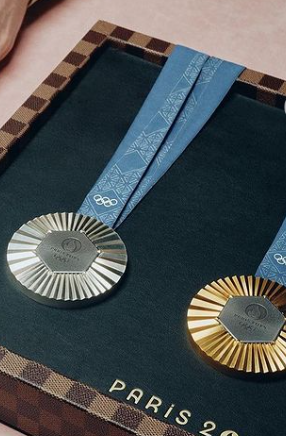
Government largesse made China an athletic powerhouse while collegiate sports keeps America a sporting superpower. The two countries, two systems, clashed at the 2024 Paris Olympics, and while both landed the same quantity of gold, the Americans were awash with more silver and bronze.
Yes, the Americans went home with a bigger haul in a virtual repeat of the Tokyo Olympics, where they won one more gold than the Chinese (39-38) and racked up a bigger medal tally (113-89).
Medal tally
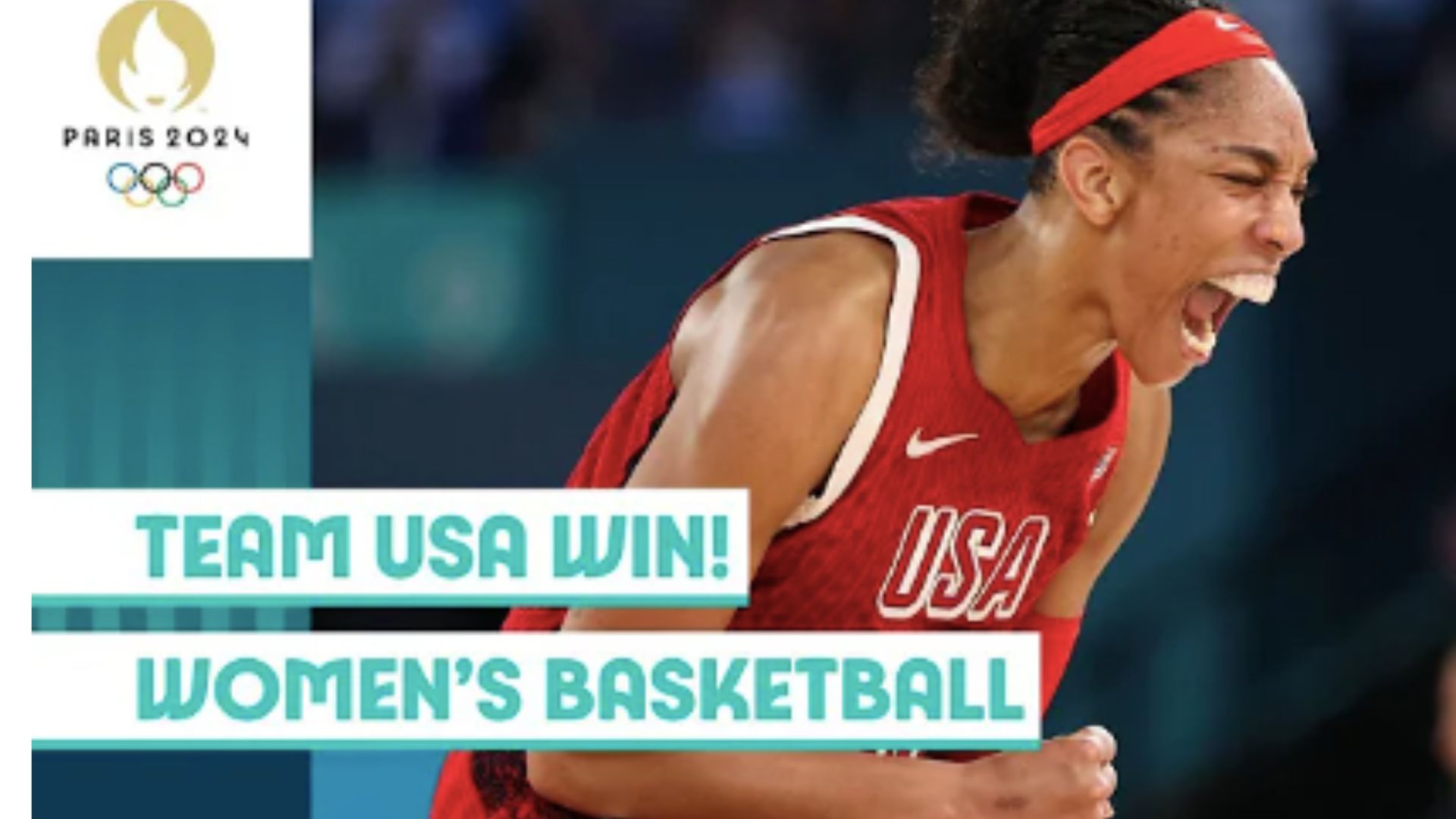
China was leading in the gold haul in Paris until the final day when weightlifter Li Wenwen won the 40th gold medal for China with her victory in the women’s +81 kg. But the Americans caught up to China with two last-day golds — with Jennifer Valente’s victory in women’s cycling and a one-point win over France (67-66) in the women’s basketball final.
So, though China and the USA won 40 gold medals each, the Americans topped the standings for their superior medal tally—44 silver, 42 bronze, 126 medals in all—compared to the Chinese—27 silver, 24 bronze, 91 in all.
“China’s Olympic delegation at Paris 2024 achieved its best overseas performance since it comprehensively participated in a Summer Olympics abroad in 1984, said Zhou Jinqiang, deputy head of the delegation at a press conference held on Sunday,” reported China Daily.
“China’s sports delegation, consisting of 404 athletes competing in 232 events across 30 sports, clinched 40 gold, 27 silver and 24 bronze medals. The haul of gold medals surpassed the 39 golds won at the London Olympics, and a total of 60 athletes claimed golds, marking a new record for overseas Olympic participation, Zhou said.”
At Beijing 2008, China won 48 gold medals and 100 overall.
“You have won glory for our country and people, and we extend warm congratulations and heartfelt compliments to you,” read a message jointly sent by the Central Committee of the Communist Party of China (CPC) and the State Council, China’s cabinet.
“Your outstanding achievements and performances have further ignited the patriotism of Chinese people both at home and abroad, uplifted the national spirit, and united the people towards progress,” added the message.
As the message shows, the Olympics are not just a sporting event but a means to boost Chinese morale and burnish the Chinese image abroad.
China’s billion-dollar sports budget
Karishma Vaswani wrote on Bloomberg: “China has long invested heavily to push its athletes to triumph against the West, as a way of highlighting the merits of the Communist Party. These Olympic Games are no different, but for one key aspect: Citizens are openly questioning why Beijing is spending so much money on a sporting event when many at home are facing bleak economic prospects.”
“China’s budget for sports this year stands at more than $1 billion,” she added. “Compare that to Australia, which also does pretty well in Olympic competitions, but last year only had around a quarter of that at its disposal. American athletes don’t get money from the government, instead they rely on a mix of private sponsorships, philanthropy, broadcast revenue and endorsements.”
The American way delivers great results, too, as the Paris Olympics showed.
How many Americans won medals?
The Washington Post noted: “The Americans won 126 medals, and because of team sports and relays, more than 40 per cent of the team’s delegation of nearly 600 athletes received at least one. Forty-four American athletes won multiple medals and 110 won at least one gold, with that large number stemming from the country’s success in team events.”
The Americans won team events like basketball, women’s gymnastics, men’s 4x400m relay, women’s 4x100m relay, women’s 4x400m relay, women’s 4x100m medley relay, men’s 4x100m freestyle relay, and mixed 4x100m medley relay.
The Chinese won team events such as the men’s 4x100m medley relay, group all-around rhythmic gymnastics, women’s synchronized diving, men’s synchronized diving, men’s artistic gymnastics, men’s and women’s canoe double, men’s doubles, women’s doubles and mixed doubles in badminton. As China Daily noted, 27 of the 40 gold medals won by China came from its six traditionally strong sports — diving, table tennis, badminton, gymnastics, shooting and weightlifting.
The US sporting world is very different. Athletes like sprinter Noah Lyles and basketballer Stephen Curry are celebrities. Their fame and fortune are hard-earned, honed by intensive training and the toughest competition.
US college sports system
As Britain’s two-time Olympic champion and World Athletics president Sebastian Coe, a legendary middle-distance runner, said, “U.S. track and field has a lot to owe to the college system.”
The New York Times says American Olympic officials “know that the American college sports system, which every year sustains and trains thousands of students in Olympic sports — both Americans and international students — is their golden goose.”
Indeed, American colleges and universities train not only American athletes. Top international athletes, too, like the swimmer Leon Marchand of France and the sprinter Julien Alfred of Saint Lucia, have been trained in America. Marchand was a member of the Arizona State University swim team, Alfred trained at the University of Texas.
The overwhelming majority of Olympic medals come from sports that have a presence on college campuses, says the Times.
No amount of government largesse, like the billions reportedly spent by China, has yet reduced the US college-trained athletes to also-rans. In fact, as the Paris Olympics showed, the latter still have an edge.
Counting the remaining months before the Paris Olympic Games 2024, there is a lot that we must know about what will transpire in the French City. Here is a list of the 24 things that we need to know about Paris 2024 which you can confidently and enthusiastically share with your family and friends.
Top five things to know about Paris Olympics
The official dates of the 2024 Olympic and Paralympic Games happening in Paris are July 26-August 11, and August 28-September 8 respectively.
The Paris 2024 competitions in the fields of football and rugby will begin on July 24, two days before the official opening ceremony.
The 2024 Paris Olympics will be a century from the time the 1924 Paris Olympics was held.
Paris and London hosted the Olympics three times. London during the 1908, 1948, and 2012 games while Paris during 1900, 1924, and 2024.
Almost one hundred years will pass between the 2024 Olympics opening ceremony in Paris on July 26, and the 1924 Closing Ceremony on July 27 in the same city.
How many medals?
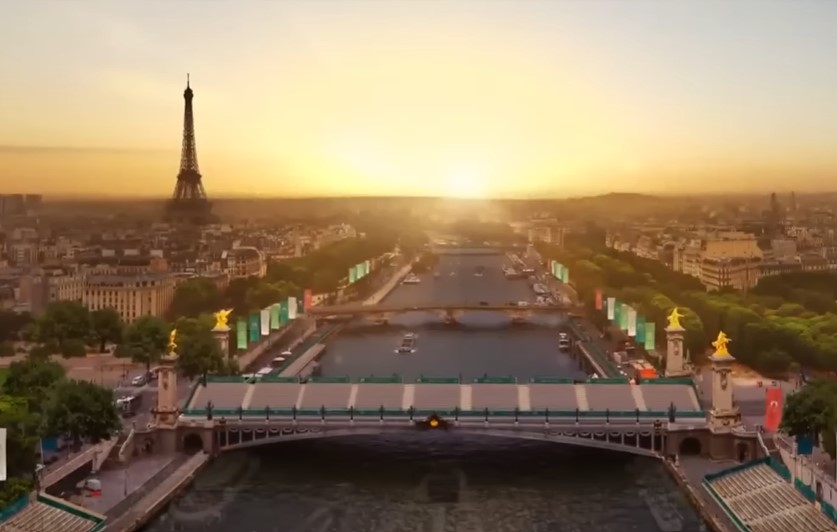
The Paris 2024 opening ceremony won’t be having a stadium hosting because it will be held at the Seine, the river that runs through the heart of Paris.
The 2024 Olympics will feature 32 sports and 329 event medals.
Most medals will be awarded in the field of aquatics with 49 events– diving, water polo, artistic swimming, marathon swimming, and swimming. Athletics will come in next with 48 events.
The number of expected athletes that will be participating is roughly 10,500. The final number will be confirmed after the conclusion of the Olympic Qualifier Series.
Breaking is a new sport that will be added in the Paris 2024 Olympics. Dance sports will comprise two events– one for men and one for women– where 16 B-Boys and 16 B-Girls will fight in solo bouts.
Thousands of volunteers
An estimated number of 45,000 volunteered to offer help at the Paris 2024 Olympics.
13 out of the 35 venues will be used to accommodate different sports. These are all within ten kilometers of the Olympic Village.
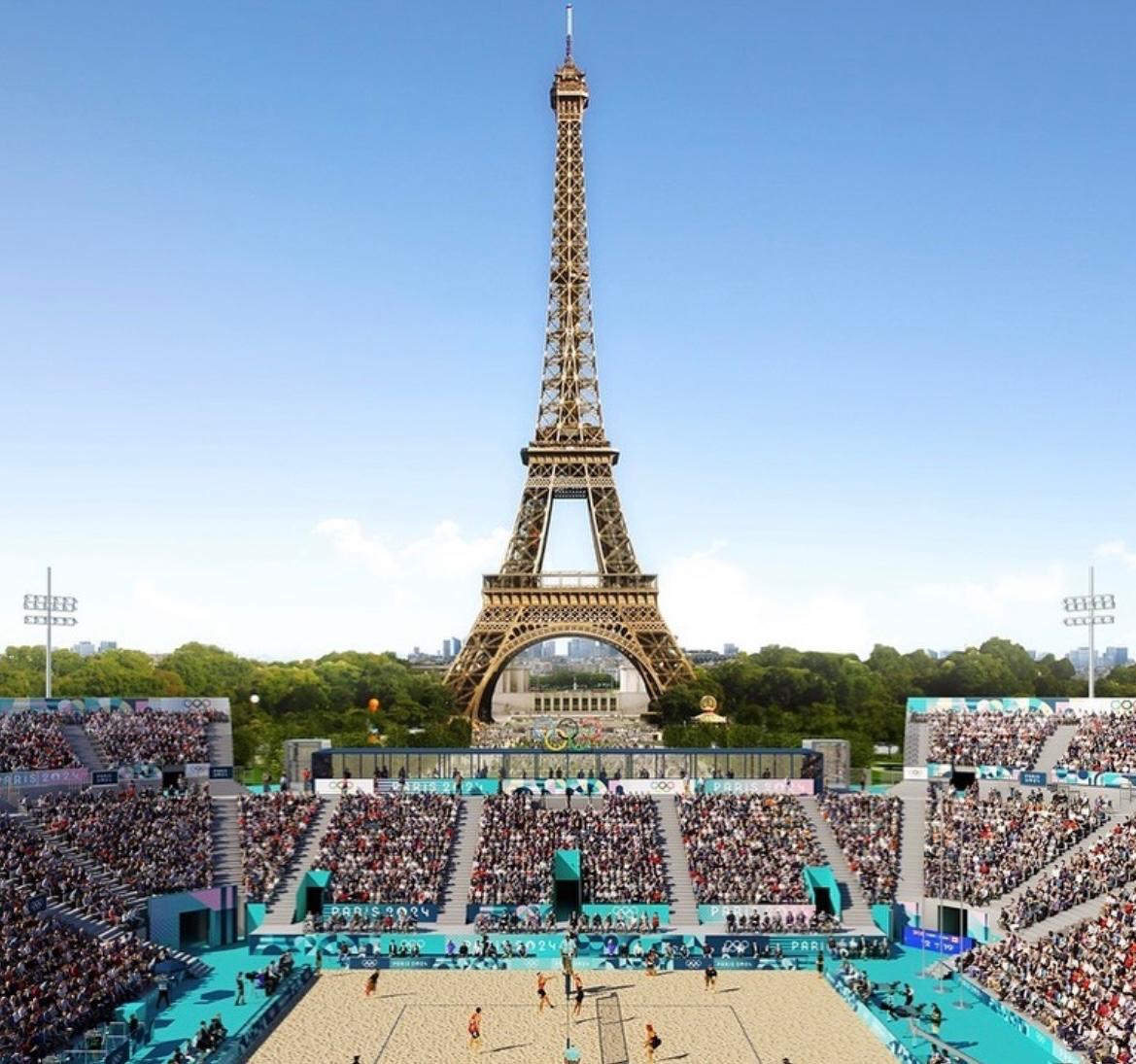
Some of the Olympic events will take place in well-known locations throughout Paris such as the Champ de Mars (below the Eiffel Tower) for beach volleyball, La Concorde for urban sports, the Grand Palais for fencing and taekwondo, and the Hotel de Ville for the marathon start.
Sports events will not just be held in the nation’s capital. Events in sailing will be held in Marseille, team sports will be held in Lille, and football matches will be held in Bordeaux, Nantes, Lyon, Saint-Etienne, Nice, and Marseille.
The surfing sport will happen on the famed Teahupoo wave on the Pacific island of Tahiti, which is almost 15,000 kilometers from Paris.
Extreme slalom is a new canoe event that will debut in the 2024 Olympics. Athletes tip off a ramp simultaneously, and the winner is the first person to reach the bottom of the course. A separate event will be made for men and women.
There will be two new sailing categories in Paris 2024 One is IQFoil, which is windsurfing, and the other is formula kite, also referred to as kite surfing.
The 35-kilometer walking mixed relay in running, the Skeet mixed team event in shooting, and the mixed Dinghy in sailing are three new mixed events that will also debut in the 2024 Paris Olympics.
A 32 year wait for Paris
The Olympic Games will return to France for the first time in 32 years. The last Olympics to take place in France was the Winter Games in Albertville in 1992.
The format of sport climbing, which debuted at Tokyo 2020 in 2021, will be altered for 2024. For every gender, there will be two distinct medal events in Paris 2024: one for a combined event that solely consists of bouldering and lead, and another for speed climbing.
The Modern Pentathlon will use a new format that will run precisely 90 minutes. Riding will be the first activity, followed by the fencing bonus round and swimming. The event will end with the laser run with combined shooting and running. There will be breaks between 5-15 minutes per activity.
Almost 10 million tickets will be on sale for the Paris 2024 Olympics, and around 3.4 million for the 2024 Paralympics. Tickets will be sold via a single website. Click here to know more.
There will be an IOC Refugee Olympic Team that will compete in Paris 2024. Back in Rio 2016, the first refugee squad competed. The Refugee Olympic Team aims to give hope to millions of Refugees around the world.
Indeed, the Olympics is a global platform for the inspiring collaboration of athletics, culture, and unity. As we look forward to this years’ games, may we be reminded of the significance of friendship, excellence, and mutual respect.
The grand opening ceremony happening on July 26, Friday, along the Seine River presented an unusual security challenge. Organizers are hoping that these security measures won’t detract from the festive atmosphere as Paris finalizes preparations for the Summer Olympics.
For the first time, the opening ceremony for the Games will not take place in a stadium. Thousands of athletes and entertainers will be transported by dozens of boats in a 6-kilometer (3.7-mile) floating procession down the Seine, exhibiting the history and splendor of the French city.
The president of the Paris 2024 organizing committee, Tony Estanguet, said: “There’s a balance to be found between top security, which is absolutely the priority… It’s part of the objective to guarantee the security and to propose a fantastic celebration of the Games… But to have this kind of unique celebration, you also need to have a very, very strong security plan. And that’s the case.”
What to expect at the opening ceremony
More than 300,000 viewers, including members of France’s elite special intervention forces with counterterrorism training, are expected to line both banks of the river to witness the ceremony, which will also be attended by 45,000 police officers. An anti-drone system will be installed along with sharpshooters stationed atop buildings along the route.
France is already at its highest degree of security due to the wars in Gaza and the Ukraine as well as domestic security issues. The environment of the last Summer Olympics in Tokyo in 2021, when the competition was staged in empty venues and a year later than planned because of the COVID-19 epidemic, was very different from the Paris Olympics expected to be attended by masses.
Over the course of 18 days of competition in the French city and other locations, the Paris 2024 Olympic Games will include 3,800 hours of live events and award 329 gold medals in 32 different sports.
The Paris 2024 Olympics will officially begin on July 26, with an opening ceremony. Rather than being held in a stadium, the grand opening ceremony will be held along the Seine River for this year’s Games.
However, the official start of sporting events will be on July 24, days prior to the opening ceremony, with events in football, rugby sevens, handball, and archery.
What’s new for Paris 2024
Breaking is the only new sport scheduled for the 2024 Olympics. This dance form had its start in the 1970s in the Bronx in New York, but it has since developed into a competitive sport. This sport will not be seen in Paris until the latter part of the Games; the men’s event is scheduled for August 10 and the women’s for August 9. There will be 32 competitors in total—16 males and 16 women—who will fight for the medals.
Furthermore, karate and baseball/softball were eliminated from the Olympics this year, despite their inclusion in Tokyo three years ago.
Additionally, Kayak Cross will make its premiere. It’s similar to canoe slalom, but instead of racing against the clock, each heat sets four participants against one another.
The sailing competition now includes two new kite events: kiteboarding and windsurfer-iQFoil. Moreover, men will compete in artistic swimming for the first time in Olympic history, and a team acrobatic routine round will make its debut.
Olympic prize money
The World Athletics has declared that it will be the inaugural international federation to present cash prizes during the Olympic Games. The international governing body announced that a total reward fund of $2.4 million (£1.9 million) has been made available for the Olympics in Paris this summer. The gold medal winners will receive $50,000 (£39,400).
Russian and Belarusian athletes
Athletes from Belarus and Russia may compete as Individual Neutral Athletes, or AIN.The International Olympic Committee has announced that they will not be participating in the opening ceremony of the 2024 Summer Olympics as well.
Dates to remember
Opening ceremony: July 26, River Seine
Archery: July 25 to August 4, Invalides
Artistic gymnastics: July 25 to August 4, Bercy Arena
Artistic swimming: August 5-10, Bercy Arena
Athletics: August 1-11, Stade de France (track & field), Trocadero (race walks), Invalides (marathons)
Badminton: July 27 to August 5, La Chapelle Arena
3×3 Basketball: July 30 to August 5, La Concorde
Basketball: July 27 to August 11, Pierre Mauroy Stadium (group phase) & Bercy Arena (finals)
Beach volleyball: July 27 to August 10, Eiffel Tower Stadium
Boxing: July 27 to August 10, North Paris Arena & Roland-Garros Stadium
Breaking: August 9-10, La Concorde
Canoe slalom: July 27 to August 5, Vaires-sur-Marne Nautical Stadium – White water
Canoe sprint: August 6-10, Vaires-sur-Marne Nautical Stadium – Flat water
Cycling BMX: July 30 to August 2, La Concorde (freestyle), BMX Stadium (racing)
Cycling mountain bike: July 28-29, Elancourt Hill
Cycling road: July 27 to August 4, Pont Alexandre III (time trials), Trocadero (road races)
Cycling track: August 5-11, National Velodrome
Diving: July 27 to August 10, Aquatics Centre
Equestrian: July 27 to August 6, Chateau de Versailles
Fencing: July 27 to August 4, Grand Palais
Football: July 24 to August 10, Bordeaux Stadium, Geoffroy-Guichard Stadium, La Beaujoire Stadium, Lyon Stadium, Marseille Stadium, Nice Stadium & Parc de Princes (finals)
Golf: August 1-10, Le Golf National
Handball: July 25 to August 11, South Paris Arena (group stage), Pierre Mauroy Stadium (knockout phase)
Hockey: July 27 to August 9, Yves-du-Manoir Stadium
Judo: July 27 to August 3, Champ-de-Mars Arena
Marathon swimming: August 8-9, Pont Alexandre III
Modern pentathlon: August 8-11, North Paris Arena (ranking round), Chateau de Versailles
Rhythmic gymnastics: August 8-10, La Chapelle Arena
Rowing: July 27 to August 3, Vaires-sur-Marne Nautical Stadium – Flat water
Rugby sevens: July 24-30, Stade de France
Sailing: July 28 to August 8, Marseille Marina
Shooting: July 27 to August 5, Chateauroux Shooting Centre
Skateboarding: July 27 to August 7, La Concorde
Sport climbing: August 5-10, Le Bourget Climbing Venue
Surfing: July 27 to August 4, Teahupo’o, Tahiti
Swimming: July 27 to August 4, Paris La Defense Arena
Table tennis: July 27 to August 10, South Paris Arena
Taekwondo: August 7-10, Grand Palais
Tennis: July 27 to August 4, Roland Garros
Trampoline gymnastics: August 2, Bercy Arena
Triathlon: July 30 to August 5, Pont Alexandre III
Volleyball: July 27 to August 11, South Paris Arena
Water polo: July 27 to August 11, Aquatics Centre, Paris La Defense Arena