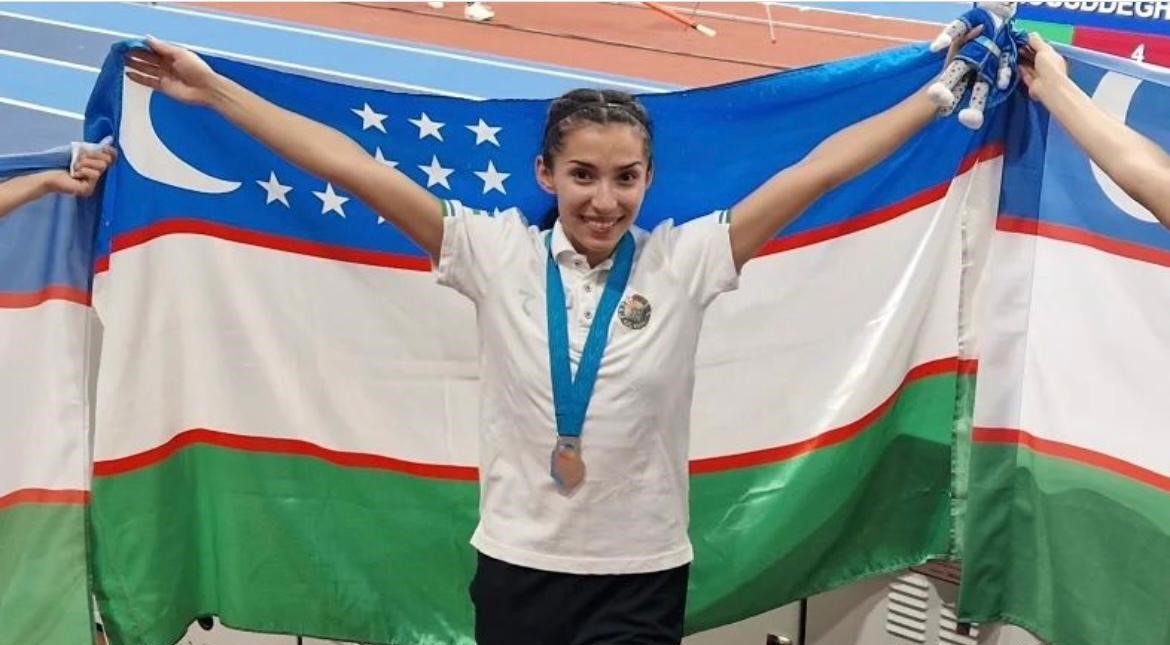
Farida Soliyeva, a young athlete from Uzbekistan, is facing a major career setback as a result of a punitive verdict by the Athletics Integrity Unit (AIU).
With Soliyeva’s bloodstream showing the banned drug Meldonium in her system, she was subject to accusations of doping and was therefore banned from all sports for three years.
This decision, which takes effect on September 13, 2023, represents a turning point in Soliyeva’s career and a harsh warning about what happens when anti-doping rules are broken.
Soliyeva – Bad Luck
Soliyeva’s luck fell apart quickly when she competed in the 2023 Asian Athletics Championships in Bangkok. The 22-year-old competitor was disqualified during the competition, which led to prompt drug tests.
“Due to the presence or use of meldonium, an illegal substance, Farida Soliyeva (Uzbekistan) has been prohibited by the AIU for three years starting on September 13, 2023. DQ findings dated July 13, 2023” essentiallysports.com said.
The course of Soliyeva’s career darkened as her urine samples were examined closely in a laboratory recognized by the World Health Organization in Bangkok. The DQ findings from July 13, 2023, as analyzed by the AIU, confirmed the dire conclusion.
Nigeria has seen a recent surge in the number of athletes being penalized for their involvement in drug-related activities. In 2021, the Commonwealth Games gold medalist in the 100 and 200 meters, Blessing Okagbare, was sentenced to a ten-year ban following a positive test for multiple drugs.
And just two weeks ago, former NCAA sprint champ Divine Oduduru was also banned for six years for drug-related infractions. Oduduru was convicted of possession and use or attempted use of multiple prohibited substances in the leadup to the 2020 Tokyo Olympics
Nzubechi Grace Nwokocha
The Athletics Integrity Unit (AIU), responsible for monitoring doping cases in track and field, has announced a three-year suspension for Nigerian sprinter Nsubechi Grace Nwokocha. This penalty stems from her positive test for two anabolic agents in a sample collected on August 3, 2022. The AIU revealed this decision, stating, “Nzubechi Grace Nwokocha (Nigeria) receives a 3-year ban, effective from August 3, 2022, due to the Presence/Use of Prohibited Substances (Ostarine & Ligandrol). Disqualification of results since August 3, 2022.”
The AIU has banned Nzubechi Grace Nwokocha (Nigeria) for 3 years, from 3 August 2022, for the Presence/Use of Prohibited Substances (Ostarine & Ligandrol). DQ results since 3 August 2022.
According to the AIU, Nwokocha admitted to the violation and accepted the sanction. Consequently, her results from August 3, 2022, to September 2, 2022, including her Commonwealth Games gold medal, have been disqualified, according to Premium Times. Also, she won’t be able to compete in any events until August 3, 2025.
“The Athlete agrees to be sanctioned with a period of Ineligibility of three (3) years; the Parties agree that taking into consideration the criteria in Rule 10.8.2 of the ADR, the period of Ineligibility shall commence on the date of Sample collection, i.e., 3 August 2022. Therefore, the period of Ineligibility shall be in effect until, and including, 2 August 2025; and in accordance with Rule 10.10 of the ADR (and to the extent that any results are not already disqualified by operation of the CGF Decision), the Athlete’s competitive results from 3 August 2022 until the date of the Provisional Suspension imposed by the AIU viz. 2 September 2022 are Disqualified with all resulting consequences, including forfeiture of any medals, points and prize money/prizes.”
With the AIU’s verdict, Nigeria has lost another one of its most valuable athletes in the form of Nwokocha, leaving the nation with a less formidable presence in the Olympic Games.
This season marks the beginning of major changes to South Dakota’s track and field timing system, changing the way results are sent into the state meet qualification procedure for both Class A and Class B divisions.
The world of athletics depends as much on time as does life. These modifications are expected to give the sport a new pulse and highlight the complex relationship between effort and result on the field and on the track.
To ensure uniformity throughout the state, the South Dakota High School Activities Association has made a major change and now demands completely automatic timing for meet results to be considered for the state meet.
South Dakota – new rules
Athletes no longer need to place in the top two to qualify for the state meet at the May region track meets; instead, they must place among the top 24 in their class to achieve qualification.
These regional competitions, particularly in Class A and Class B, go from being important qualifiers to ceremonial meetings with the attention now on the top-24 list, ushering in a new era in South Dakota’s high school track and field scene.
The need for automatic timing devices has increased in the fast-paced world of track meetings, especially since Class A and Class B now mandate their use in order for meetings to be considered official. The racing experience is transformed by these electronic marvels that capture race times with ease and without the need for manual intervention.
Once considered a luxury, they are now essential, ensuring accurate and dependable timing. These methods are the foundation of contemporary sports, improving competition and streamlining procedures while also establishing new standards for effectiveness and fairness on the track.
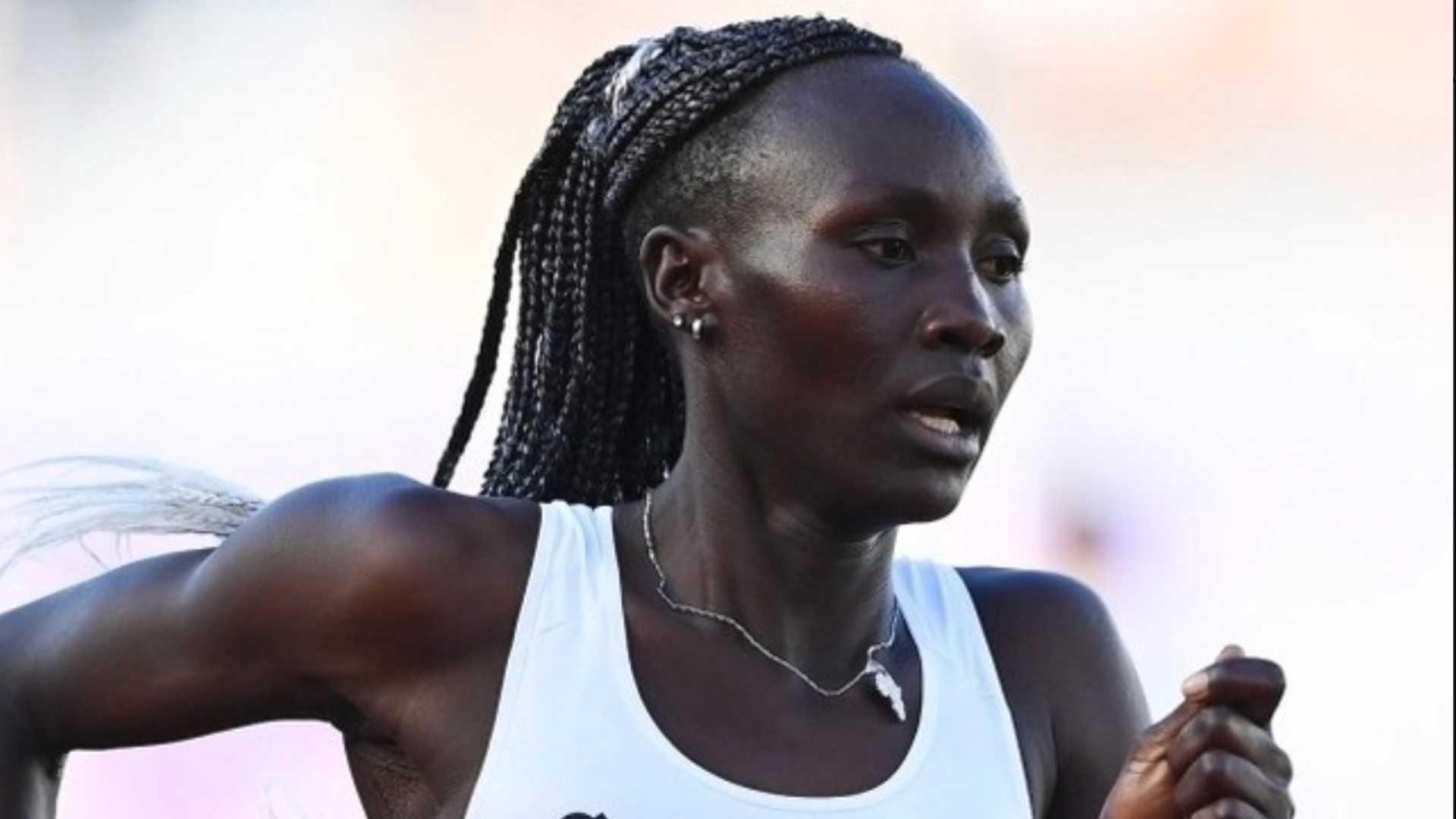
The Athletics Integrity Unit announced that Anjelina Nadai Lohalith, who competed in the 1,500 meters as a refugee athlete in the Olympics in 2016 and 2021, has been suspended following a positive test result for the prohibited substance Trimetazidine (TMZ).
South Sudanese-born Lohalith, who last participated in the international cross-country championships in Belgrade at the end of March, will be banned from racing for four years.
She is the third refugee apprehended by the sports authorities because of positive testing for illegal drugs in recent months.
Lohalith and others
Fouad Idbafdil from Morocco, who competed in the 2019 world championships in Doha, was sentenced to three years in jail in December after he acknowledged using the hormone EPO, which is prohibited for enhancing endurance.
More so, Dominic Lokolong Atiol, a distance runner also from South Sudan and is currently staying in Kenya, was also suspended for the same reasons as Lohalith last March.
The World Anti-Doping Agency has prohibited TMZ since 2014. TMZ is used to treat angina and enhances blood flow to the heart.
A total of 73 athletes who are refugees are receiving scholarships from the International Olympic Committee (IOC) to help them compete for slots at the 2024 Paris Summer Olympics. Three years ago, there were 29 athletes in the refugee team who competed at the Tokyo Olympics.
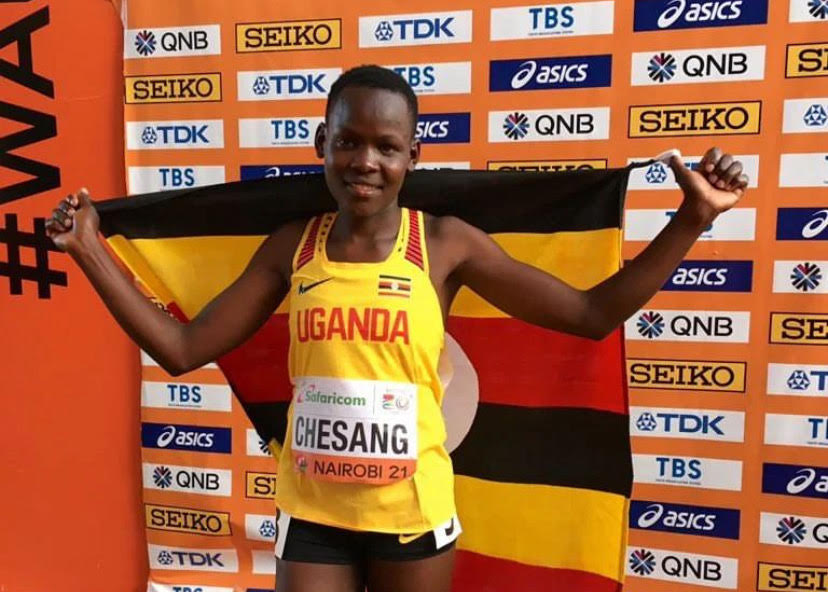
The Athletics Integrity Unit (AIU) has just announced the latest athlete that’s been provisionally suspended for doping, and to the shock and dismay of many, it was Uganda’s very own rising middle- and long-distance runner, Prisca Chesang.
Chesang’s suspension
Doping is often seen as a last resort for athletes who have exhausted all other avenues for success in the sport, so Chesang’s involvement with doping and suspension came as a complete surprise, as she was on the cusp of success.
The youngster has had her fair share of achievements in recent years. The Ugandan athlete had won the bronze medal in the 5000 metres and placed fourth in the 3000 meters at the 2021 World Athletics Under-20 Championships. The following year, Chesang replicated her victory in the 5000 meters event and again snagged a bronze medal for her country.
Her win at the 2022 edition was especially noteworthy and well-received because it was Uganda’s only medal in the competition.
Prisca Chesang does it again. Just like it was in Nairobi last year the teenager clinches Uganda's only medal at the #WorldAthleticsU20 Championships in Cali Colombia after finishing 3rd in the Women's 5000m finals with a time of 15:31:17. One for the future, what a talent!!! pic.twitter.com/7u4Bc3jLV0
In addition, Chesang also competed in the 10-kilometer San Silvestre Vallecana road race in 2022, finishing ahead of a strong field of many older and more seasoned long-distance runners. She beat Francine Niyonsaba and Beatrice Chepkoech to win the title in an incredible time of 30:19.
Her accomplishments stood testament to her talents and skills that were well beyond her years, and there was no doubt that she was poised to become one of Uganda’s most outstanding track and field athletes.
However, with AIU’s latest findings and suspension, Chesang’s career will be forced to take a back seat.
AIU’s report
Declared on December 6, the AIU has provisionally suspended Chesang for the ‘presence or use of a prohibited substance’ called Furosemide, which is a flagrant breach of the World Anti-Doping Rules. The 20-year-old has been charged under Articles 2.1 and 2.2 of the World Anti-Doping Agency (WADA).
According to Running Magazine, furosemide has been prohibited by WADA for decades because, despite being a diuretic medication that increases urination and helps the body rid itself of excess water and salt, it also hides the presence of other performance-enhancing substances in the body.
The AIU has provisionally suspended Prisca Chesang (Uganda) for the Presence/Use of a Prohibited Substance (Furosemide).
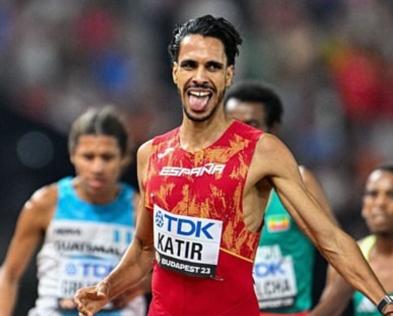
The Spanish superstar Mohamed Katir has been unexpectedly ruled out of the 2025 world championship in Tokyo and the forthcoming Olympics in Paris. The 25-year-old, who now owns the outdoor 5,000-meter record for Europe and the world record for indoor 3,000-meter swimming, has acknowledged breaking an anti-doping rule as a result of three whereabouts errors.
Katir’s brilliant career, which included victories in the 5,000 meters in Budapest last year and the 1,500 meters in Eugene, Oregon, the year before, is severely damaged by this two-year ban. Fans are left wondering about the once-promising star’s future on the track after this setback for the record holder.
Katir confirms suspension
A statement issued on February 7 by Katir publicly confirmed his provisional suspension, which was a stunning development. The Athletics Integrity Unit (AIU) disclosed on Friday that Katir had signed an admission of breach and acceptance of consequences form this week, notwithstanding her original declarations to challenge the ban.
The acknowledgment is made in response to three whereabouts errors that took place on February 28, April 3, and October 10, 2023. As a result, Katir will be disqualified from competition for two years, concluding on February 6, 2026. This event opens a new chapter in Katir’s career and makes one think about how crucial compliance is in the sports industry.
Brett Clothier said: “Without accurate Whereabouts information, anti-doping organizations cannot properly execute no-notice, Out-of-Competition testing that is the key to catching anyone who is doping and trying to gain an unfair advantage,” an article from reuters shared.