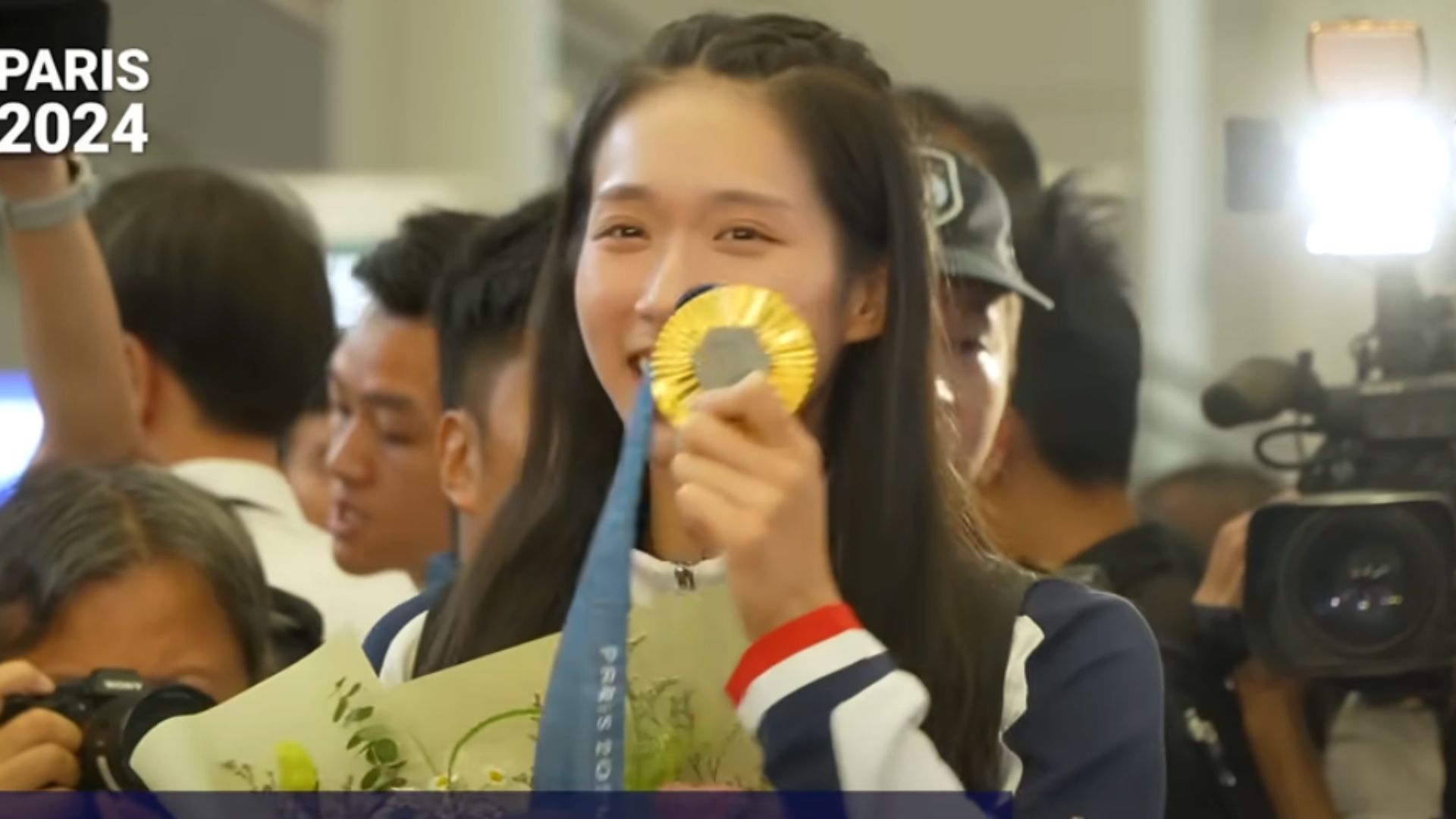
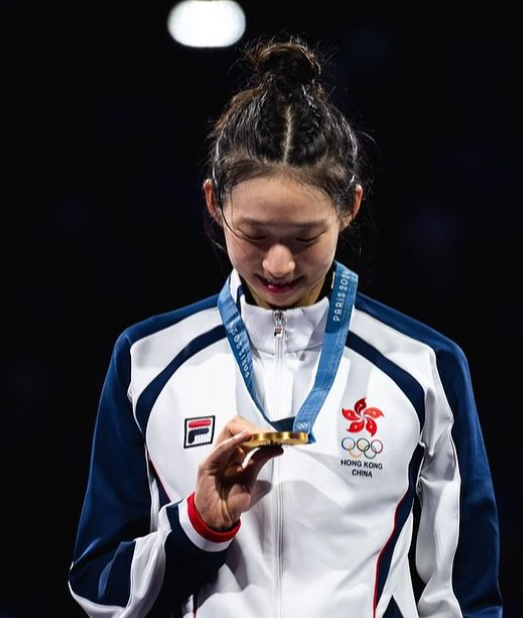
In sheer determination and skill, Hong Kong’s Vivian Kong Man Wai etched her name into Olympic history on July 28, clinching the city’s third-ever gold medal at the Paris Olympics.
The victory was all the more remarkable as it came against the formidable world No. 1, France’s Auriane Mallo-Breton, in the women’s épée finals.
The stage was set for a dramatic showdown, with the French crowd roaring in support of their champion and even President Emmanuel Macron in attendance, adding to the electric atmosphere.
Breton seemed to have the upper hand early on, surging to a commanding 7-1 lead. However, Kong was not to be underestimated.
Electrifying finish for Hong Kong’s Vivian Kong
In a display of resilience that captivated viewers worldwide, Kong began her comeback, slowly but surely chipping away at Breton’s lead. The tension was palpable as the score reached 12-12, setting the stage for an electrifying finish. It was Kong who struck the decisive blow during extra frames, securing a narrow 13-12 victory that sent shockwaves through the arena.
“I didn’t want to lose so badly,” Kong shared after the match, her determination evident. “I didn’t want to give up without showing the Hong Kong spirit.”
1st Hong Kong female gold medallist
Kong’s triumph is not just a personal milestone but a historic moment for Hong Kong. She became the first female fencer from the city to win an Olympic gold medal, following in the footsteps of legendary windsurfer Lee Lai-shan, who won Hong Kong’s first-ever gold at the Atlanta Olympics in 1996, and fencer Cheung Ka-long, who secured the city’s second gold in men’s foil at the 2020 Tokyo Olympics.
The impressive victory was commended by the city’s leader, John Lee, and the residents were thrilled about securing such an early triumph in the Olympic Games.
As Hong Kong celebrates this remarkable achievement, Kong’s victory serves as an inspiring reminder of the power of perseverance and the indomitable spirit of a true Olympian.
Experts predict that new fencing stars may emerge when Hong Kong’s Vivian Kong hangs up her blade
Gold medallist and épéeist Vivian Kong Man-wai announced on Sunday her plan to “take a break” from professional fencing after nearly 20 years in the sport. However, veteran athletes predict the emergence of more stars as the city enters its “harvest period” and hope that authorities will build more facilities to better engage the public.
Experts said that Hong Kong’s historic success in fencing at the Paris Olympics is the culmination of decades of strategic planning and substantial investment in nurturing talent.
Kong and foilist Cheung Ka-long, who won two gold medals at the Olympics in Paris, triumphantly returned to the city, creating a frenzy of fencing similar to what happened three years ago when Cheung won his first gold in Tokyo.
Both athletes credited their success to the mentorship and inspiration of their forebears, who left a tradition of distinction in the field.
Kong said; “Since our generation has more resources than our elders did, we can afford to follow our aspirations. They accomplished tremendous things with less than half of what we have.”
Vivian Kong cemented her status as one of the finest athletes in the country by becoming the first Hong Kong athlete to win a gold medal at the 2024 Summer Olympics in Paris.
The Hong Kong government is proud of her extraordinary accomplishment and has awarded her a hefty monetary bonus of $768,000, demonstrating its commitment to helping top athletes. Kong is probably enjoying her victory right now and thinking about how best to use this huge prize money.
As a testament to the country’s great esteem for sports and international presence, Hong Kong is well known for its substantial Olympic athlete rewards programme. While a silver medallist gets a nice $380,000, the real highlight is the gold medal bonus.
Athletes from Hong Kong win $1 million for a gold medal, more than the $270,000 given to gold medal winners from the United States. The $730,000 difference highlights the different objectives and resources that different nations devote to helping their Olympic competitors, and it also highlights Hong Kong’s remarkable dedication to inspiring elite achievements in the international arena.
Vivian Kong’s victory: An attestation to commitment and patriotism
The gold medal Vivian Kong won at the Olympics is proof of the unwavering commitment and enormous amount of work needed to achieve at such a high level. Her accomplishment serves as a source of motivation for upcoming generations of Hong Kong athletes as well as a source of pride in the country.
Every Olympic medal symbolizes the amazing journey competitors go on to become the best in their discipline; they are the culmination of years of intense training, sacrifice, and determination.
Kong can enjoy her current accomplishments and prepare for future events with a fresh sense of confidence, thanks to the financial support from the government and national recognition. Her experience serves as an inspiring example of how the right support can have a significant impact on an Olympic athlete’s growth and career.
Olympic debutante Zheng Qinwen becomes China’s first Olympic tennis singles champion; she won’t be the last, says Xinhua
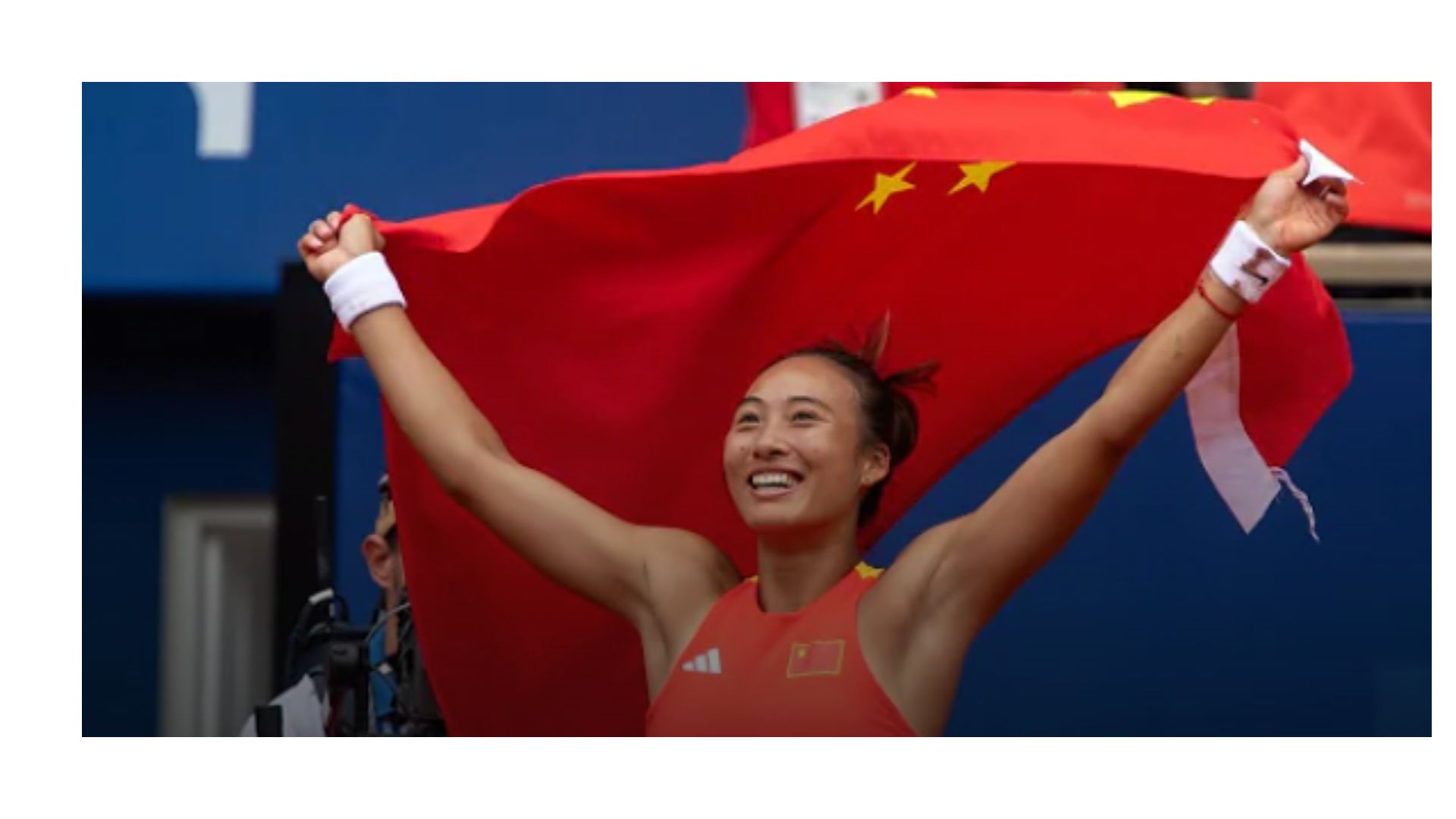
Olympic debutante 21-year-old Zheng Qinwen, became the first Chinese player to win an Olympic tennis singles gold medal when she defeated Croatia’s Donna Vekic 6-2, 6-3 in a thrilling final in Paris on Saturday (August 3).
She won’t be the last Chinese Olympic tennis champion, asserted China’s Xinhua News Agency in a burst of patriotic pride.
Praising the young tennis player, Xinhua said: “At 21, the gold could perhaps be the first of many medals for her at the Olympics, or it could be her last. However, one thing is for sure: the gold, and the inspiration that it will provide to young girls and boys back in her homeland, won’t be the last for China.”
Zheng’s victory completed a memorable week for China after Wang Xinyu and Zhang Zhizhen claimed the silver medal in the mixed doubles in tennis on Friday.
Though a new face in the Summer Games, Zheng had already proved her mettle. She was a finalist in the 2024 Australian Open, where she lost to the defending Aryna Sabalenka.
In the Paris Olympic final, she seemed the stronger contender. Zheng is the world No 7, her opponent Donna Vekic, 28, is No. 21.
Zheng also caused the biggest upset in the tournament beating the favourite and world No 1 Iga Swiatek In the semi-finals.
Moreover, she had the crowd behind her. A large Chinese contingent inside Roland Garros’s Court Philippe Chatrier cheered her on.
Vekic also had a good run. She advanced to the semi-finals at Wimbledon before competing in the Paris Olympics, where she defeated the US Open champion Coco Gauff.
Zheng, however, got the better of Vekic, defeating her in straight sets with the same powerful serves and groundstrokes she used to eliminate Iga Swiatek in the semi-finals.
Serving for the match at 5-3, Zheng reached match points as Vekic drove a backhand wide. Zheng finished the match with a well-placed forehand winner before falling to her back with joy.
Poland’s Swiatek finished with the bronze medal after beating Slovakia’s Anna Karolina Schmiedlova 6-2, 6-1 on Friday. She snapped a selfie with Zheng and Vekic during the medal ceremony.
“To win a medal for Croatia was a lifelong dream,” the 28-year-old said. “I wanted gold but still so happy and so proud. She was better than me today and deserved it.”
China’s only other Olympic gold medal in tennis came in 2004 when Li Ting and Sun Tian-Tian won the women’s doubles in Athens.
Zheng’s aspirations
Zheng said she wanted to be a role model. “I always want to become one of the Asians that can inspire young kids and make them love tennis more, because tennis is such a great sport, especially for girls. You need to fight. You need to have strength. You need to be fast,” said Zheng, who signed several autographs for members of the crowd after the match. “After this gold medal, I feel, finally, I can play tennis more relaxed.”
She still has to match her idol, though. Zheng looks up to Li Na, the only Chinese player to win Grand Slam singles titles — at the 2011 French Open and 2014 Australian Open .
“I have always been jealous of history-makers like Li Na,” Zheng said. “No matter what, she’s always the first, because she’s the first Asian player to win a Grand Slam. And I now become the first Asian player to win Olympic gold. I made history, as well. However, I still have a long way to go, because winning a Grand Slam is always my dream.”
She also spoke about her parents, who introduced her to tennis when she was seven years old. Her mother left her her job when she was 12 to make sure she ate and slept properly. Her father always pushed her hard, making her practise even on the Chinese New Year, when “everybody rests. But me? There’s no day of rest.”
“My success is not only my success. A lot of that is coming from my parents,” Zheng said. “They teach me how to be disciplined. They teach me how to stay focused on your dream. They always believed in me.”
“This Olympic journey has not been easy,” she said. “But there is a strength holding me. I never give up.”
Zheng said, “I felt like I represented all of Chinese tennis, knowing the Chinese people were cheering for me. Winning the gold made all the hard work and struggles worthwhile,” reported Xinhua.
Olympic fencer Maxine Esteban wins her ticket to the 2024 Paris Olympics
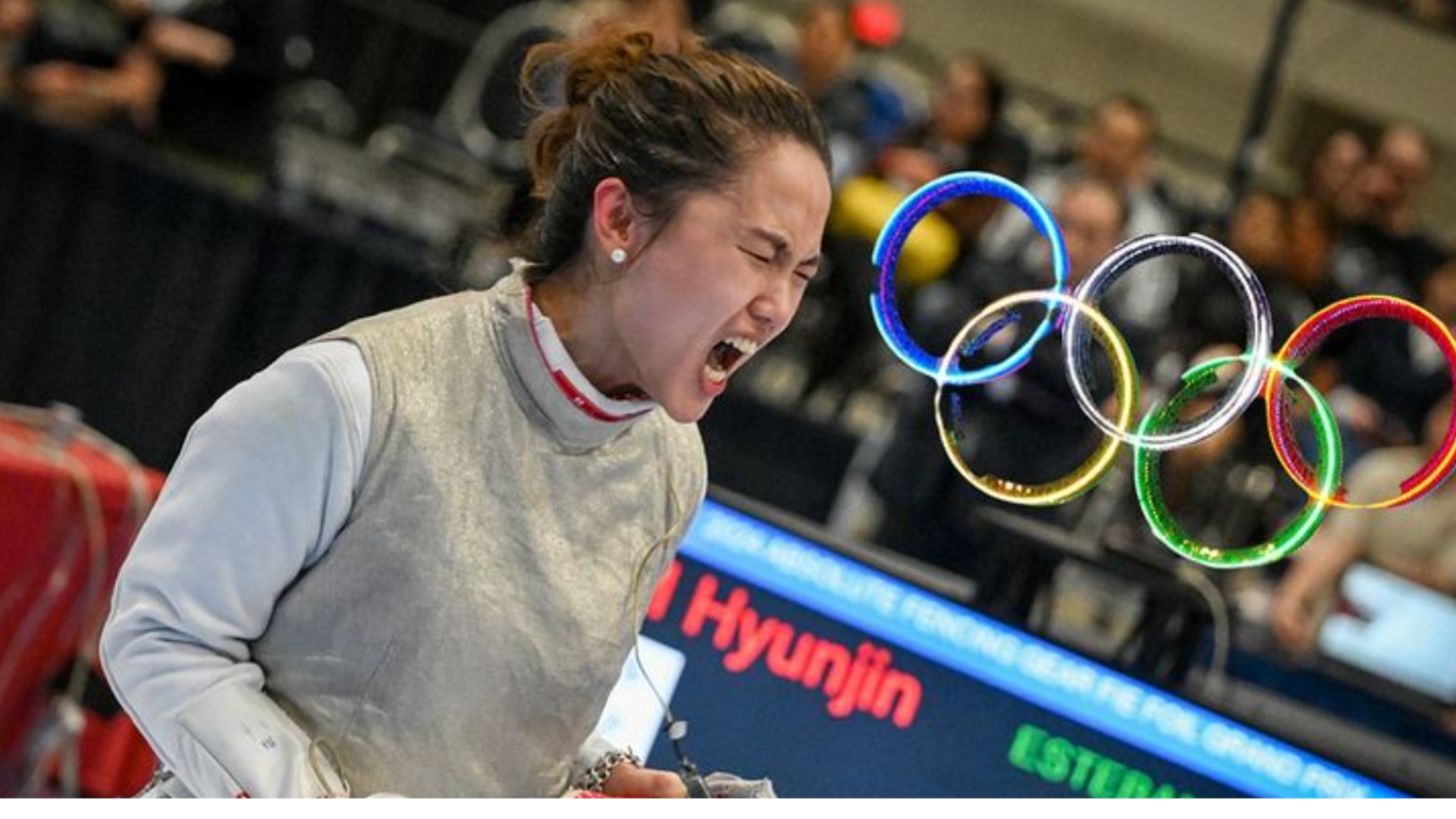
In a social media post, Filipino-Ivorian fencer Maxine Esteban triumphantly announced her qualification for the 2024 Summer Olympics happening in Paris. She secured her spot by gaining the 83rd spot in the 2024 Absolute Fencing Gear FIE Foil Grand Prix that took place in Washington, USA.
Her performance in the said competition allowed her to top the qualifying race for the Africa continental zone, which secured her place at the Olympics.
In her Instagram post, Esteban expressed how blessed she is to be participating in the Olympics.
She stated: “I am at a loss for words…This journey is truly a testimony of God’s faithfulness. Today, I am in awe of His love for me and I am grateful He has carried me through. For all the 2nd chances, opened windows, miraculous feats, and generous provisions, thank you Heavenly Father.”
Esteban: A dreamer
She also declared that the Olympic stage is not just an event for her, but it symbolizes passion and discipline. Through this opportunity, Maxine wants to become an inspiration to many to continue dreaming against challenges and difficulties.
“May I inspire those who dream and have at one point almost given up, to persist amidst storms and rough waters,” she expressed.
Maxine announced that she had changed federations from the Philippines to the Ivory Coast due to “self-respect.” It was reported that she was dropped by the Philippine Fencing Association prior to her federation switch, allegedly because of her refusal to compete in the Philippine qualifiers.
Nevertheless, she offers her win and her Olympic journey to both countries that helped her in her fencing career.
“This is for Cote d’Ivoire, the country that embraced me, believed in me and supported me all the way, and for the Philippines, the country my heart will always beat proud. 🇨🇮❤️🇵🇭” she concluded her post.
In the previous edition of the Asian Games in 2018, South Korea dominated the fencing competition, clinching a total of six gold medals at the event. The country’s success was mostly attributed to the male fencers winning in the Team foil, Individual sabre, and Team sabre competitions.
This year at the Hangzhou Asian Games, the South Koreans replicated their victory and bagged the gold medal at the Team sabre event. Their powerhouse roster, which featured Oh Sang-guk, Kim Jun-ho, and Gu Bon-gil, also collectively known as “the Avengers,” got off to a great start in the men’s sabre competition, making it to the final with ease. In the final, they upset their Chinese opponents in the nine-bout final with a score of 45-33.
Gu Bon-gil, 34, has added another gold medal to his collection of Asian Games honors, bringing his total to six with the Hangzhou success.
“The teamwork was very good and the home crowd was cheering really loudly, but it wasn’t a problem for us,” Gu said in a statement.“(Oh) promised me we would win gold in the team match.”
South Korea Wins
“I dedicate my individual silver medal to my wife and my gold to my baby son.”
In addition, their female compatriots also won gold for the Land of the Morning Calm at the Individual and Team Epée events, with Choi In Jeong winning the Individual title and the women’s team winning the Team Epée event.
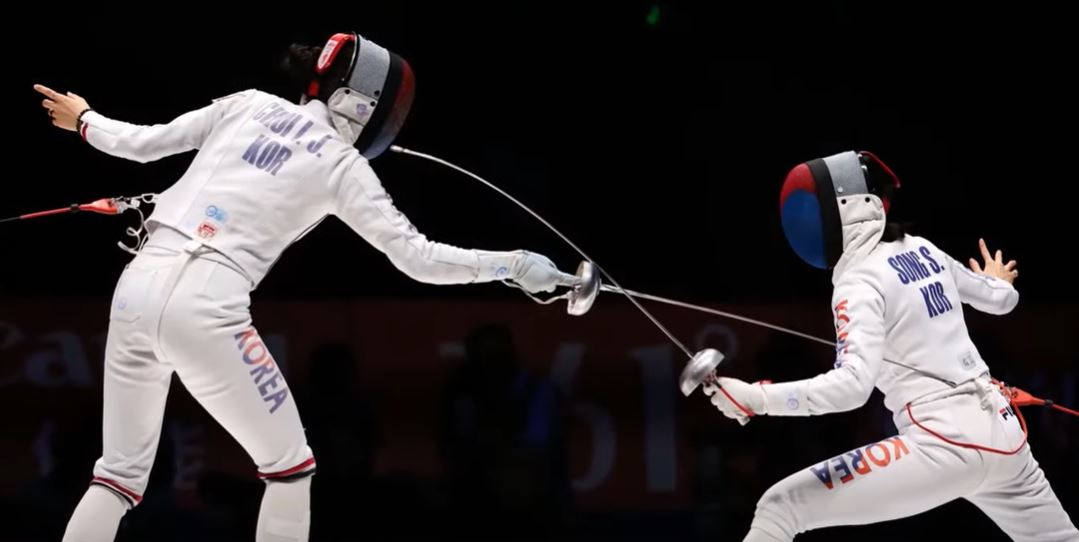
In the Individual Epée, the final round featured an all-Korean showdown between Choi In Jeong and Song Se-ra. In a close fight, Choi defeated Song 9-8, emerging victorious and clinching her first ever Asian Games gold.
Meanwhile, in the Team Epée event, the South Korean women’s team rejoiced as they clinched gold, as this put an end to a 21-year gold medal drought for the country.
With their top-notch performance in the Asian Games, fans are now looking forward to South Korea’s fencing team at the Paris Olympics in 2024, which will be held from July 26 to August 11.