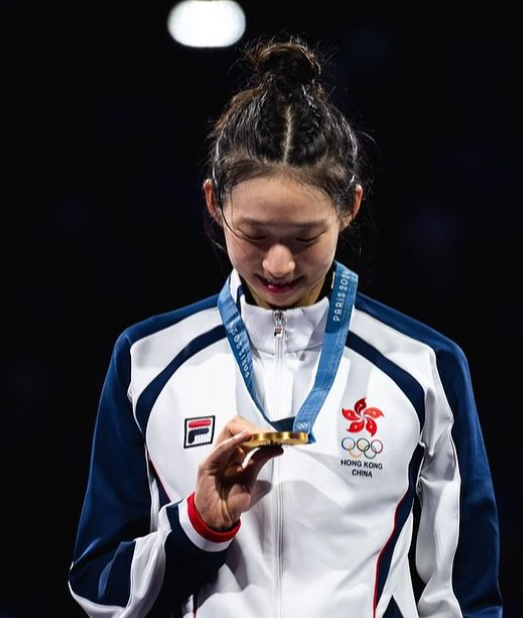
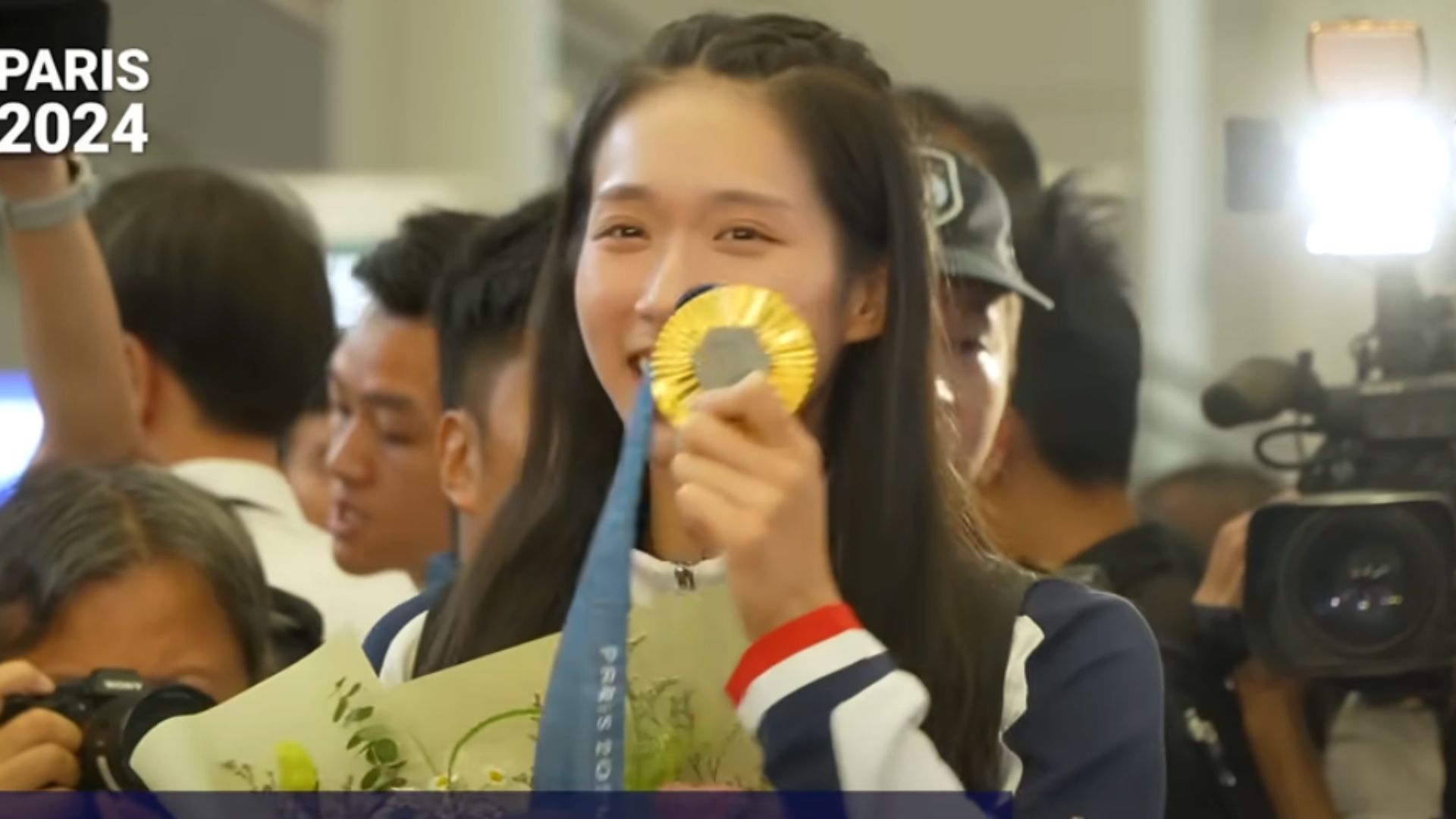
Vivian Kong cemented her status as one of the finest athletes in the country by becoming the first Hong Kong athlete to win a gold medal at the 2024 Summer Olympics in Paris.
The Hong Kong government is proud of her extraordinary accomplishment and has awarded her a hefty monetary bonus of $768,000, demonstrating its commitment to helping top athletes. Kong is probably enjoying her victory right now and thinking about how best to use this huge prize money.
As a testament to the country’s great esteem for sports and international presence, Hong Kong is well known for its substantial Olympic athlete rewards programme. While a silver medallist gets a nice $380,000, the real highlight is the gold medal bonus.
Athletes from Hong Kong win $1 million for a gold medal, more than the $270,000 given to gold medal winners from the United States. The $730,000 difference highlights the different objectives and resources that different nations devote to helping their Olympic competitors, and it also highlights Hong Kong’s remarkable dedication to inspiring elite achievements in the international arena.
Vivian Kong’s victory: An attestation to commitment and patriotism
The gold medal Vivian Kong won at the Olympics is proof of the unwavering commitment and enormous amount of work needed to achieve at such a high level. Her accomplishment serves as a source of motivation for upcoming generations of Hong Kong athletes as well as a source of pride in the country.
Every Olympic medal symbolizes the amazing journey competitors go on to become the best in their discipline; they are the culmination of years of intense training, sacrifice, and determination.
Kong can enjoy her current accomplishments and prepare for future events with a fresh sense of confidence, thanks to the financial support from the government and national recognition. Her experience serves as an inspiring example of how the right support can have a significant impact on an Olympic athlete’s growth and career.
In sheer determination and skill, Hong Kong’s Vivian Kong Man Wai etched her name into Olympic history on July 28, clinching the city’s third-ever gold medal at the Paris Olympics.
The victory was all the more remarkable as it came against the formidable world No. 1, France’s Auriane Mallo-Breton, in the women’s épée finals.
The stage was set for a dramatic showdown, with the French crowd roaring in support of their champion and even President Emmanuel Macron in attendance, adding to the electric atmosphere.
Breton seemed to have the upper hand early on, surging to a commanding 7-1 lead. However, Kong was not to be underestimated.
Electrifying finish for Hong Kong’s Vivian Kong
In a display of resilience that captivated viewers worldwide, Kong began her comeback, slowly but surely chipping away at Breton’s lead. The tension was palpable as the score reached 12-12, setting the stage for an electrifying finish. It was Kong who struck the decisive blow during extra frames, securing a narrow 13-12 victory that sent shockwaves through the arena.
“I didn’t want to lose so badly,” Kong shared after the match, her determination evident. “I didn’t want to give up without showing the Hong Kong spirit.”
1st Hong Kong female gold medallist
Kong’s triumph is not just a personal milestone but a historic moment for Hong Kong. She became the first female fencer from the city to win an Olympic gold medal, following in the footsteps of legendary windsurfer Lee Lai-shan, who won Hong Kong’s first-ever gold at the Atlanta Olympics in 1996, and fencer Cheung Ka-long, who secured the city’s second gold in men’s foil at the 2020 Tokyo Olympics.
The impressive victory was commended by the city’s leader, John Lee, and the residents were thrilled about securing such an early triumph in the Olympic Games.
As Hong Kong celebrates this remarkable achievement, Kong’s victory serves as an inspiring reminder of the power of perseverance and the indomitable spirit of a true Olympian.
Experts predict that new fencing stars may emerge when Hong Kong’s Vivian Kong hangs up her blade
Gold medallist and épéeist Vivian Kong Man-wai announced on Sunday her plan to “take a break” from professional fencing after nearly 20 years in the sport. However, veteran athletes predict the emergence of more stars as the city enters its “harvest period” and hope that authorities will build more facilities to better engage the public.
Experts said that Hong Kong’s historic success in fencing at the Paris Olympics is the culmination of decades of strategic planning and substantial investment in nurturing talent.
Kong and foilist Cheung Ka-long, who won two gold medals at the Olympics in Paris, triumphantly returned to the city, creating a frenzy of fencing similar to what happened three years ago when Cheung won his first gold in Tokyo.
Both athletes credited their success to the mentorship and inspiration of their forebears, who left a tradition of distinction in the field.
Kong said; “Since our generation has more resources than our elders did, we can afford to follow our aspirations. They accomplished tremendous things with less than half of what we have.”
After winning an amazing 6 kg of gold and $525,000 (RM2.32 million) in prize money in table tennis, China’s rising star Chen Meng is expected to be the highest-paid among the Chinese athletes who competed in the 2024 Summer Olympics in Paris.
With gold in the women’s singles and women’s team events, she had an incredible performance that earned her this substantial reward. According to China Business Daily, the majority of her bonus comes from real estate mogul Guo Bin, who is married to gold medallist Wang Nan from the 2004 Athens Olympics.
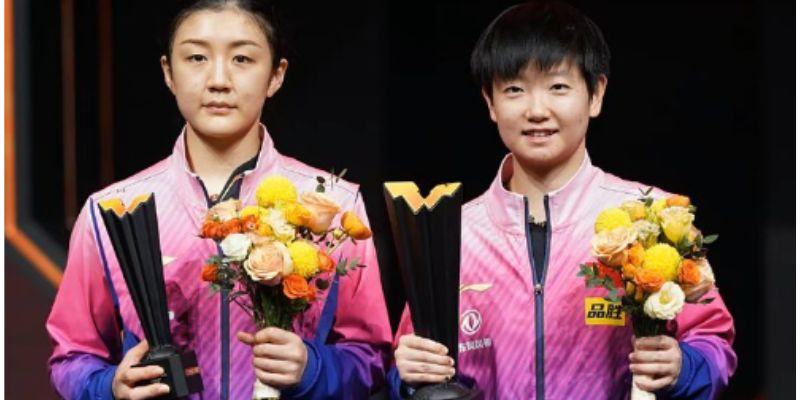
Guo Bin created news ahead of the women’s singles championship match when she promised the victor 6 kg of gold. Chen, 30, stepped up to the plate and won gold in the women’s singles and women’s team competitions at the last two Olympics, defeating her fellow countrywoman, Sun Yingsha.
Chen outperformed the top-seeded Sun in the 2024 Paris Olympics despite being the second seed competing. Her victory caps off an incredible career that included second-place finishes in the 2019 and 2023 World Championships and a victory in the 2020 Table Tennis World Cup.
Guo Bin and Wang Nan’s training centre fuels China’s historic sweep at Paris Olympics
Famous names in Chinese table tennis, Guo Bin, and Wang Nan, have made a major impact on the game by founding a top-notch training facility in Weihai City, Shandong province, which is frequently used by the national team.
China, displaying its supremacy, created history at the Paris Olympics by being the first country to win gold in all five table tennis categories: women’s singles, men’s singles, mixed doubles, men’s team, and women’s team. In the mixed doubles competition, which debuted at the Tokyo Olympics in 2020, China lost to Japan surprisingly in the championship match.
Paris Olympics: China’s billions vs US college sports
Government largesse made China an athletic powerhouse while collegiate sports keeps America a sporting superpower. The two countries, two systems, clashed at the 2024 Paris Olympics, and while both landed the same quantity of gold, the Americans were awash with more silver and bronze.
Yes, the Americans went home with a bigger haul in a virtual repeat of the Tokyo Olympics, where they won one more gold than the Chinese (39-38) and racked up a bigger medal tally (113-89).
Medal tally
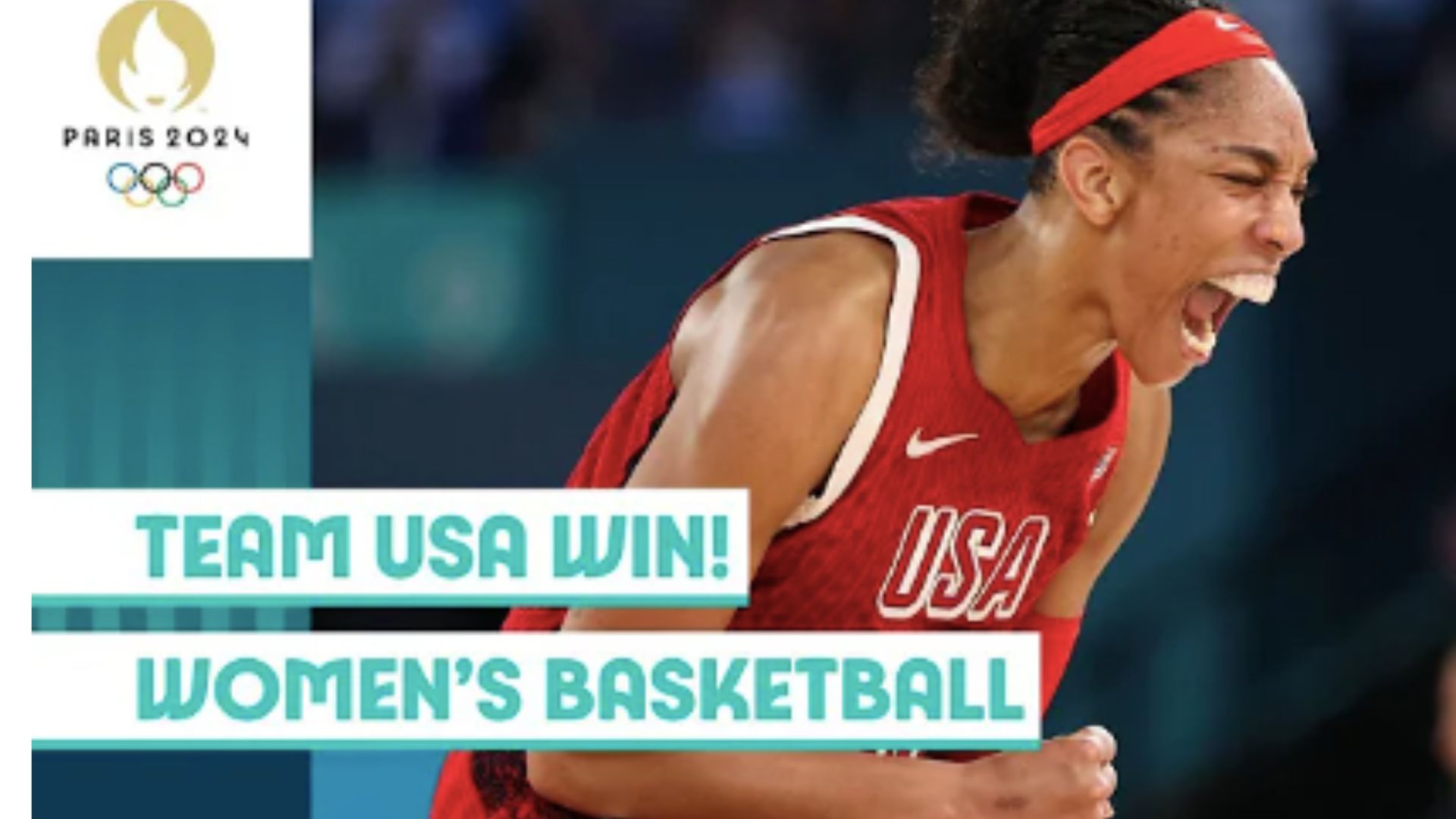
China was leading in the gold haul in Paris until the final day when weightlifter Li Wenwen won the 40th gold medal for China with her victory in the women’s +81 kg. But the Americans caught up to China with two last-day golds — with Jennifer Valente’s victory in women’s cycling and a one-point win over France (67-66) in the women’s basketball final.
So, though China and the USA won 40 gold medals each, the Americans topped the standings for their superior medal tally—44 silver, 42 bronze, 126 medals in all—compared to the Chinese—27 silver, 24 bronze, 91 in all.
“China’s Olympic delegation at Paris 2024 achieved its best overseas performance since it comprehensively participated in a Summer Olympics abroad in 1984, said Zhou Jinqiang, deputy head of the delegation at a press conference held on Sunday,” reported China Daily.
“China’s sports delegation, consisting of 404 athletes competing in 232 events across 30 sports, clinched 40 gold, 27 silver and 24 bronze medals. The haul of gold medals surpassed the 39 golds won at the London Olympics, and a total of 60 athletes claimed golds, marking a new record for overseas Olympic participation, Zhou said.”
At Beijing 2008, China won 48 gold medals and 100 overall.
“You have won glory for our country and people, and we extend warm congratulations and heartfelt compliments to you,” read a message jointly sent by the Central Committee of the Communist Party of China (CPC) and the State Council, China’s cabinet.
“Your outstanding achievements and performances have further ignited the patriotism of Chinese people both at home and abroad, uplifted the national spirit, and united the people towards progress,” added the message.
As the message shows, the Olympics are not just a sporting event but a means to boost Chinese morale and burnish the Chinese image abroad.
China’s billion-dollar sports budget
Karishma Vaswani wrote on Bloomberg: “China has long invested heavily to push its athletes to triumph against the West, as a way of highlighting the merits of the Communist Party. These Olympic Games are no different, but for one key aspect: Citizens are openly questioning why Beijing is spending so much money on a sporting event when many at home are facing bleak economic prospects.”
“China’s budget for sports this year stands at more than $1 billion,” she added. “Compare that to Australia, which also does pretty well in Olympic competitions, but last year only had around a quarter of that at its disposal. American athletes don’t get money from the government, instead they rely on a mix of private sponsorships, philanthropy, broadcast revenue and endorsements.”
The American way delivers great results, too, as the Paris Olympics showed.
How many Americans won medals?
The Washington Post noted: “The Americans won 126 medals, and because of team sports and relays, more than 40 per cent of the team’s delegation of nearly 600 athletes received at least one. Forty-four American athletes won multiple medals and 110 won at least one gold, with that large number stemming from the country’s success in team events.”
The Americans won team events like basketball, women’s gymnastics, men’s 4x400m relay, women’s 4x100m relay, women’s 4x400m relay, women’s 4x100m medley relay, men’s 4x100m freestyle relay, and mixed 4x100m medley relay.
The Chinese won team events such as the men’s 4x100m medley relay, group all-around rhythmic gymnastics, women’s synchronized diving, men’s synchronized diving, men’s artistic gymnastics, men’s and women’s canoe double, men’s doubles, women’s doubles and mixed doubles in badminton. As China Daily noted, 27 of the 40 gold medals won by China came from its six traditionally strong sports — diving, table tennis, badminton, gymnastics, shooting and weightlifting.
The US sporting world is very different. Athletes like sprinter Noah Lyles and basketballer Stephen Curry are celebrities. Their fame and fortune are hard-earned, honed by intensive training and the toughest competition.
US college sports system
As Britain’s two-time Olympic champion and World Athletics president Sebastian Coe, a legendary middle-distance runner, said, “U.S. track and field has a lot to owe to the college system.”
The New York Times says American Olympic officials “know that the American college sports system, which every year sustains and trains thousands of students in Olympic sports — both Americans and international students — is their golden goose.”
Indeed, American colleges and universities train not only American athletes. Top international athletes, too, like the swimmer Leon Marchand of France and the sprinter Julien Alfred of Saint Lucia, have been trained in America. Marchand was a member of the Arizona State University swim team, Alfred trained at the University of Texas.
The overwhelming majority of Olympic medals come from sports that have a presence on college campuses, says the Times.
No amount of government largesse, like the billions reportedly spent by China, has yet reduced the US college-trained athletes to also-rans. In fact, as the Paris Olympics showed, the latter still have an edge.
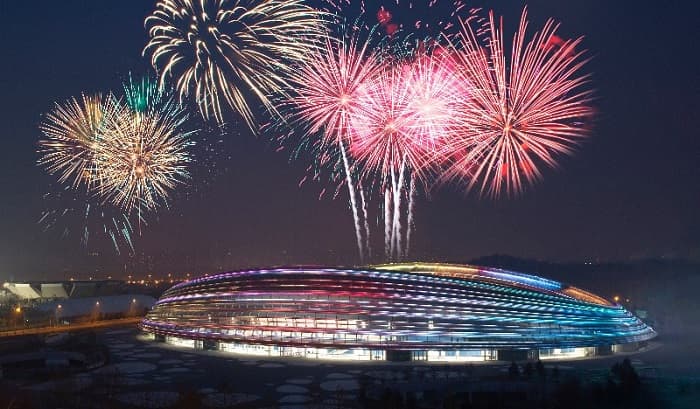
Winter Olympics is an international sporting athletic competition that takes place once in four years. This time it is officially known as XXIV Olympic Winter Games or commonly referred to as Beijing 2022. Winter Olympics 2022 is scheduled to be held in Beijing.
As we know that Winter Olympics has already begun, from 4th February 2022. The Olympics consists of 91 countries participating. However, there were many issues that rose and many countries were not permitted to participate in the winter competition. Nevertheless, the Olympics is back in full form, so let’s take a look at the details of the game, Winter Olympics 2022 Prize Money: How Much Olympic Athletes Can Earn for Winning Medals, And Sponsorship.
Winter Olympics 2022 Prize Money: How Much Olympic Athletes Can Earn for Winning Medals
When we talk about athletics, all participants eye on the winner’s prize, apart from winning a medal, they also get their hands on heft sums as prize money from their respective nations. Here we have provided a list of all the countries and the prize money each player gets for winning either of the three medals- Gold, Silver, and Bronze. So check it out now.
Countries
Gold
Silver
Bronze
Singapore
$1,000,000
$500,000
$250,000
Indonesia
$746,000
$378,000
$188,000
Kazakhstan
$250,000
$150,000
$75,000
Azerbaijan
$248,000
$124,000
$62,000
Italy
$166,000
$83,000
$55,000
France
$55,000
$22,000
$14,000
Hungary
$125,000
$89,000
$71,000
Russia
$61,000
$38,000
$26,000
USA
$37,500
$22,500
$15,000
South Africa
$37,000
$19,000
$7,000
Germany
$22,000
$17,000
$11,000
Canada
$16,000
$11,000
$8,000
Prize Money: Winter Olympics 2022 USA
According to a report by NBC, it is known to us that the U.S. Olympic winners get $37,500 for winning gold, $22,500 for winning silver, and $15,000 for winning bronze. The catch here is that the US offers this sum on each medal, so for instance if an athlete tries to get two gold medals along with a bronze, he packs a total sum of $90,000.
In reality, there was an athlete named Caeleb Dressel, who won five gold medals and made $187,500 at the recently held Tokyo Olympics 2020.